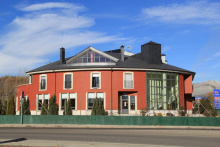
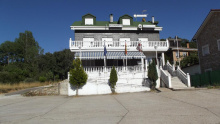
Crossing a Roman bridge into Nestar, the camino leaves Cantabria and enters Palencia. The village has an outdoor exposition on the Roman Road with a milario (milestone) and an ancient bridge — a good place to appreciate the route's long history. Nestar makes a possible shorter stop before Aguilar de Campoo.
Limited services.
Accommodation in Nestar.
| Casa Rural La Galana | |
| Casas Villa Esperanza |
| Hotel Rural Amontes Rural |
Grijera is a small hamlet between Nestar and Aguilar de Campoo. No services. The camino approaches Aguilar through increasingly agricultural terrain.
Aguilar de Campoo is the biggest town between Arija and Cervera de Pisuerga, with all services. It was walled in medieval times, and some vestiges remain along with houses bearing large coats of arms. The Rio Pisuerga runs along one side of the center with a pleasant promenade.
The Colegiata de San Miguel has Visigothic origins, though what stands now is mainly late Romanesque and Gothic — the choir stalls and baptismal font are highlights. But the real prize is the Romanesque church of Santa Cecilia, on the edge of town below the castle. Get the keys from the Casa del Cura across from the Colegiata — hand over your passport and you'll have the church to yourself. The capital of the Slaughter of the Innocents is exquisite, and the experience of unlocking a Romanesque church for a private visit is unforgettable.
Hotel Valentin includes breakfast. The Posada Santa Maria La Real, at the edge of town on the camino, is the splurge option — a converted monastery with a cloister. Aguilar also has a Romanesque institute with a museum, though its opening hours can be unpredictable.
The walking from Aguilar is lovely — lots of off-road and river walking. Head down the promenade to the monastery, continue to the reservoir, and go up and around on the right (don't cross the dam).
The first surprise is the anthropomorphic tombs just past Corvio, probably 10th century — the bodies were oriented with feet facing east. From there, lots of field walking, then at Salinas de Pisuerga you cross the Rio Pisuerga and walk alongside it for 12 km into Cervera. About 1-2 km before Cervera, a sign points to the Ermita Rupestre de San Vicente, about 500 m off-camino — a medieval rock hermitage with more anthropomorphic tombs. Highly recommended.
Accommodation in Aguilar de Campoo.
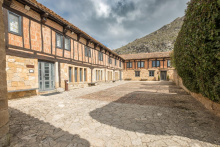
Just past Corvio, look for the anthropomorphic tombs, probably dating to the 10th century. These carved-out stone burial sites were made so that bodies always had their feet facing east. A quiet, atmospheric spot.
No services in the village.
Matamorisca is a small village between Corvio and Salinas de Pisuerga. No services. The camino passes through pleasant agricultural countryside with the Montana Palentina mountains visible ahead.
Salinas de Pisuerga is a small village where the camino crosses the Rio Pisuerga and begins the 12 km riverside walk into Cervera de Pisuerga. The crossing is the start of one of the most pleasant stretches on the Olvidado. The village has a bar.
Accommodation in Salinas de Pisuerga.
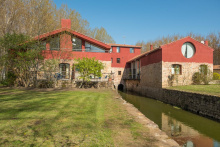
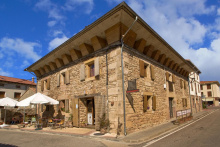
Barcenilla de Pisuerga is a small village along the Rio Pisuerga between Salinas and Cervera. No services. The riverside walking through here is easy and pleasant.
Quintanaluengos is a small village along the Rio Pisuerga. No services. The camino continues its pleasant riverside route toward Cervera.
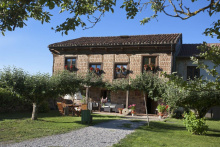
Accommodation in Quintanaluengos.
| Casa Rural La Aceña Booking.com |
|
Liguerzana is a small village on the approach to Cervera de Pisuerga along the river. No services. You're nearing the end of the 12 km riverside stretch from Salinas.
Vado is a small village near Cervera de Pisuerga. No services in the village itself.
About 1-2 km outside Cervera, a sign points to the Ermita Rupestre de San Vicente (Rock Hermitage of Saint Vincent), about 500 m off-camino. This medieval construction, carved into the rock face, has more anthropomorphic tombs and is highly recommended.
Cervera de Pisuerga is a nice little town at the foot of the Montana Palentina. It has good restaurants, cafes on the square, and a supermarket or two. The town marks the end of the lovely 12 km riverside walk from Salinas de Pisuerga.
Cervera has accommodation, shops, and all basic services.
The 39 km from Cervera to Guardo is obviously a very long day. It starts with a short ascent to an abandoned mine. From there, lots of flat off-road walking with the Montana Palentina in your sights — wide open spaces with mountains in the distance.
The route takes you through small villages that time has forgotten. There's a welcome rest stop in Santibanez de la Pena (about 27 km from Cervera), where Bar Mylo has rooms — call +34 979 860 294.
To split the stage, stop in Tarilonte de la Pena at the halfway point (20 km), where Hotel Rural El Yunque offers rooms and may let you use their kitchen. There's also Casa Rural El Encinar in the same village. A bar is open only May through September.
Accommodation in Cervera de Pisuerga.
| Albergue Juvenil Arbejal |
| Camping Municipal |
| Casa Las Vacas |
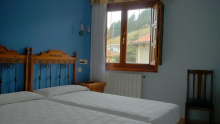
| Hotel Almirez | |
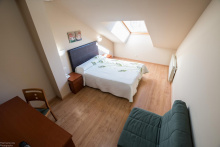
| Hotel El Roble Booking.com |
|
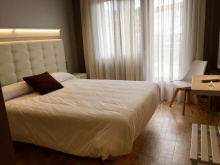
| Hotel Rural Peñalabra Booking.com |
|
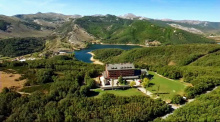
| Hotel Rural Molino de Valdesgares |
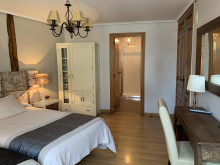
| Hostal Rural El Resbalón Booking.com |
|
Cantoral de la Pena is a small village between Cervera de Pisuerga and Castrejon de la Pena. No services. The camino climbs briefly to an abandoned mine before descending into open countryside with the Montana Palentina visible ahead.
Accommodation in Cantoral de la Peña.
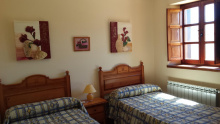
| Casas Valle de Tosande Booking.com |
|
Cubillo de Castrejon is a tiny hamlet in the Pena area. No services. The camino passes through on flat off-road paths with mountain views.
Castrejon de la Pena is a small village that serves as a local center for the area. It may have a bar, but don't count on it. The camino passes through on the long stage between Cervera and Guardo.
Accommodation in Castrejón de la Peña.
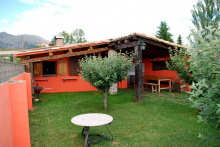
| Casa Rural El Uncar Booking.com |
|
Pison de Castrejon is a tiny hamlet between Castrejon de la Pena and Tarilonte. No services. The walking remains flat and off-road with mountain views.
Tarilonte de la Pena is the logical place to split the long 39 km stage between Cervera de Pisuerga and Guardo. Hotel Rural El Yunque offers rooms and may let you use their kitchen. They also operate Casa Rural El Encinar. A bar in the village is open only from May through September, with limited hours (1-3 pm and 7-10 pm).
Stopping here gives you two manageable 20 km days. The village has a pretty church where you can rest outside.
Accommodation in Tarilonte de la Peña.
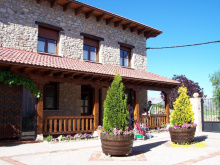
| Casa Rural El Encinar ⭑⭑⭑ Booking.com |
|
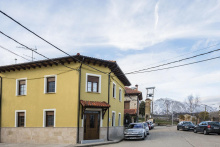
| Hotel Rural El Yunque ⭑⭑⭑ Booking.com |
|
Avinante de la Pena is a small village between Tarilonte and Santibanez. No services. The camino continues through quiet countryside with the mountains drawing closer.
Santibanez de la Pena, about 12 km before Guardo, is a welcome rest stop on this long stage. Bar Mylo has cold drinks, nice people, and rooms available — call +34 979 860 294.
Villanueva de Arriba is a small village between Santibanez de la Pena and Guardo. No services. The camino is now entering the mining belt of northern Palencia.
Accommodation in Villanueva de Arriba.
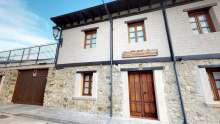
| Casa Rural La Majada Palentina Booking.com |
|
Muneca is a small village on the approach to Guardo. No services. The landscape is changing as you approach the former mining town.
Guardo is a former mining town and the largest settlement between Cervera de Pisuerga and Cistierna. The Real Hotel and the albergue are both outside the center and up a hill, at least 1.5 km from town — bring what you need unless you want to walk back down. The albergue is good and takes groups as well as individual pilgrims.
If you're taking the Caminayo mountain alternative (longer but more scenic), you'll need to go through the center of town to pick up that route. If you're taking the direct route to Puente Almuhey, the hotel and albergue are right on the camino.
Guardo has all services — supermarkets, restaurants, cafes, banks, and a pharmacy.
Two routes lead from Guardo to Puente Almuhey. The direct route (16 km) is flat and straightforward.
The mountain alternative via Caminayo (32 km, 500-600 m elevation gain) is beautiful. It descends to the river in Guardo, passes through an abandoned mining town outside Velilla del Rio Carrion, and climbs into spectacular mountain scenery. In Velilla, the ancient Tamaricas Fountains are worth seeing — according to Pliny the Elder, if the fountains are dry, you should be dead within a week. Hostal Stop in Velilla or Casa Moura (+34 979 861 098) can break up this longer route.