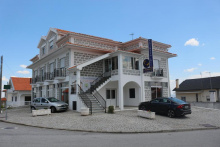
Famalicao da Serra is a small mountain village at the base of a long climb. There's a cafe but little else. The village sits within the Serra da Estrela Natural Park — Portugal's largest protected area and first national park, covering 101,000 hectares.
Nearly 1.5 km out of Famalicao on the ascent to the pass, there's a dirt road straight ahead while the switchback asphalt road turns right. Take the dirt road (there is no arrow) as it's more direct and more pleasant. Be aware that the apparent summit soon after is not the actual top — there's still another ascent to make through the forest.

Fernao Joanes is one of the oldest villages in the Fundao area, located on a counterfort of the Gardunha mountain. No services of note for pilgrims. The village is within walking distance of Fundao if you need supplies.
Meios is a tiny hamlet between Fernao Joanes and Trinta. No services. The camino passes through on quiet roads in the upper Serra da Estrela foothills.
Trinta has an albergue with 20 beds and a kitchen. To stay, call Carlos in advance on +351 966 482 853. Phone reception is poor in Trinta, so if he doesn't answer, send him a WhatsApp message instead. The village has two mini-markets and restaurants.
To arrange to stay at the albergue, call Carlos in advance on +351 966 482 853. Phone reception is poor in Trinta, so if he doesn’t answer, send him a WhatsApp message instead. The albergue has 20 beds and a kitchen, while the village has two mini-markets and restaurants.
The name Corujeira means "owlery," and there's a small owl museum filled with figurines collected over the years. Ask around the village for the key. No other services of note.
Macainhas de Baixo is a small village of about 300 inhabitants with a traditional textile heritage — the Cobertor de Papa, a blanket made from churra sheep wool, has been produced here for generations. The former Artur Freire Factory on the N338 is a reminder of the village's industrial past. There's a railway station, but limited services otherwise.
At over 1,000 m, Guarda is the highest city in Portugal — and the wind will remind you of it. The Gothic cathedral (the Se) is imposing if austere, and the castle ruins offer panoramic views over the surrounding mountains. Several medieval gates survive, of which the Torre dos Ferreiros (Blacksmiths' Tower) is the most interesting.
Guarda has all services — accommodation, restaurants, supermarkets, banks, and good transport connections by bus and rail.
Leaving Guarda, the camino becomes a Roman road almost immediately and this continues for most of the descent to Ramalhosa, making it one of the most interesting stretches on the entire Caminho Nascente.
Accommodation in Guarda (Nascente).

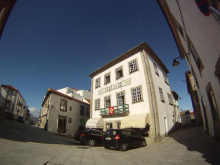

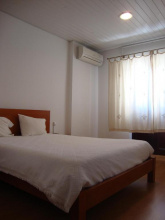
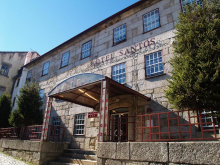
Ramalhosa is a small village at the bottom of the descent from Guarda. If you're coming from Guarda, you'll have just walked one of the best stretches on the Nascente — a Roman road that runs most of the way down. No services.
Aldeia Vicosa — formerly called Aldeia de Porco until a name change in 1939 — sits on the left bank of the Mondego Valley at the heart of the Serra da Estrela Natural Park. The village has a river beach (praia fluvial), a welcome option in summer, and a proto-historic fortified settlement at Pedra Aguda. About 267 inhabitants. No notable services for pilgrims.
Rapa is a small village between Aldeia Vicosa and Vale de Azares. No services. The camino continues through the Mondego Valley with the Serra da Estrela as a backdrop.
On several occasions after Rapa, the mass-produced arrows don't have either tip painted in yellow as they usually do, leaving them as horizontal bars. This means to go straight.
Vale de Azares is a small parish of about 330 inhabitants within the Serra da Estrela Natural Park, about 6 km from Celorico da Beira. The local economy revolves around vegetables, fruit, olive oil, honey, and artisan cheese — the Queijo da Serra, made from sheep's milk using cardosins as a curdling agent, is the signature product of the region. The village has a long-running philharmonic band but limited services.
Celorico da Beira has a castle that's worth a look for the views but not much else of note. It's a regional center for Queijo da Serra production — if you haven't tried it yet, this is the place. Residencial Parque is a decent budget accommodation option southwest of the castle.
The town has basic services — cafes, shops, a supermarket, and a pharmacy.

Forno Telheiro is a village on the right bank of the Mondego River, about 7 km from Celorico da Beira. The name likely derives from a former tile-making (tejar) industry. Look for the Manueline pillory in the center — a reminder that this was once a chartered town. The village has a railway station and is home to Celorico da Beira's industrial park, but limited pilgrim services.
Fiaes is a small village between Forno Telheiro and Trancoso. No services. You're now approaching the end of the Caminho Nascente — Trancoso is close.
Trancoso is a walled town and the third Aldeia Historica on the Nascente — a worthy finish to a 645 km camino. The gates, towers, and castle make for a dramatic arrival, and the old town within the walls rewards wandering. Among the sights, the Casa do Gato Preto (House of the Black Cat), a medieval house near the castle, is one of the most photographed buildings in town.
Restaurante O Museu is a good and popular restaurant within the walls, while Tasca do Castelo offers a pilgrim menu.
Trancoso has accommodation, restaurants, cafes, supermarkets, and transport connections.
To continue on the Camino Torres from Trancoso, take the N226 northwest from the old town past the Meu Super and pick up the arrows.
Accommodation in Trancoso.