Valencia is Spain's third-largest city and the starting point of the Camino de Levante. It's a city that rewards a day or two of exploration before setting out — and with direct flights from across Europe and excellent rail connections, it's a practical place to begin.
The old town, centered on the Barrio del Carmen, is a web of narrow streets, churches, and plazas. The Cathedral claims to house the Santo Cáliz — the Holy Grail — in a side chapel, and whether or not you believe the claim, the chalice itself is striking. Climb the Miguelete bell tower for the best views over the city. Next door, La Lonja de la Seda (the Silk Exchange) is a masterpiece of Valencian Gothic and a UNESCO World Heritage Site — the soaring columns of the main hall are worth the visit alone.
The Mercado Central, across from La Lonja, is one of Europe's largest and most beautiful food markets. If you're self-catering before setting out, this is the place to stock up — and to eat well.
The Turia Gardens, a 9-km park built in the bed of the diverted River Turia, run from the old town to the City of Arts and Sciences, Santiago Calatrava's futuristic complex of museums and performance spaces. It's a striking contrast to the medieval center.
Valencia has all services. Accommodation ranges from hostels in the old town to beachfront hotels. The city is best explored on foot or by the excellent public bike system.
Valencia was founded as the Roman colony Valentia in 138 BC. It passed through Visigothic, Moorish, and Christian hands — the legendary El Cid briefly took the city in 1094 before it was recaptured by the Almoravids. Jaume I of Aragón definitively conquered it in 1238, and the city flourished as a major Mediterranean trading port. The 15th century was Valencia's golden age, when the silk trade and banking made it one of the wealthiest cities in Europe.
Las Fallas (March 15-19) is Valencia's defining festival and one of the most spectacular in Spain. Neighborhoods spend months building enormous satirical sculptures (fallas) from wood, papier-mâché, and foam, only to burn them all on the final night (La Cremà). The daytime mascletà — a thunderous firecracker display in the Plaza del Ayuntamiento — is a daily ritual during the festival. Las Fallas is a UNESCO Intangible Cultural Heritage event.
The Camino de Levante leaves Valencia heading south through the suburbs of l'Horta Sud. The walking is urban and flat — all on roads through Alfafar, Massanassa, and Catarroja before reaching Silla at about 15 km. The official first stage goes all the way to Algemesí (38 km), but Silla is a sensible first stop.
Don't be put off by descriptions of "industrial slog" — there's a short stretch through a polígono industrial, but it's storage depots, not heavy industry. The suburban towns are pleasant enough and give you a glimpse of everyday Spanish life outside the tourist center.
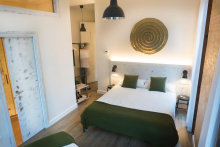
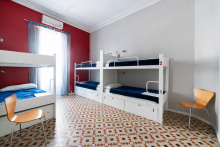
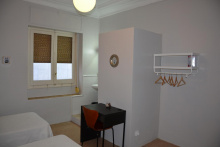
Accommodation in Valencia.
Alfafar is a suburb of Valencia in the comarca of l'Horta Sud. There's a 14th-century church worth a glance as you pass through. The town has basic services — bars, shops — but most pilgrims will push through to Silla. The walking is flat and on roads.
Massanassa is another suburb in l'Horta Sud, on the way to Silla. No notable pilgrim services. The town blends into the continuous urban fabric of greater Valencia — you'll barely notice the transition from one municipality to the next.
Catarroja sits on the edge of the Albufera Natural Park, Valencia's famous freshwater lagoon. The town itself is unremarkable for pilgrims, but if you have time, the Albufera is one of Spain's most important wetlands — it's the birthplace of paella, and the lakeside restaurants in nearby El Palmar are legendary. The camino doesn't pass through the park, but it's close.
Silla is about 15 km from Valencia and makes a sensible first stop if you don't want to push all the way to Algemesí (38 km). The town has basic services — a few bars and restaurants, a supermarket, and accommodation options including Pensión Puerto and Hostal Moreno near the camino.
Silla is on two Cercanías train lines (C1 and C2), so you could also take the train back to Valencia if you'd rather sleep in the city on your first night. There's a Moorish tower in town, though it can't be visited.
Leaving Silla, the camino follows a country road through flat agricultural land to Almussafes. The profile is flat all the way to Algemesí. After Benifaió, it's farmland again — rice paddies, orange groves, and the open sky of the Valencian plain.
Accommodation in Silla.
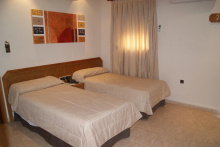
Almussafes has a Moorish tower — one of many watchtowers that dot this stretch of the Valencian coast, remnants of the medieval Muslim defense network. The town has basic services. There's accommodation here if you want to split the Valencia-to-Algemesí stretch into three short days rather than two. The Ford factory on the outskirts is the town's main employer.
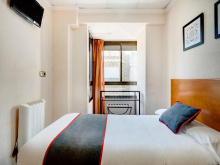
Accommodation in Almussafes.
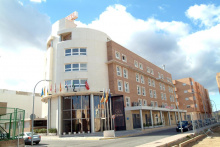
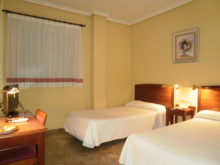
Benifaió has two Moorish towers — one in the center of town, which can be visited by request at the ayuntamiento (more interesting with a guide). The town is a pleasant Valencian agricultural community. Basic services are available. After Benifaió, the walking is through open farmland to Algemesí.
Algemesí is a working Valencian town famous for the Muixeranga, a tradition of building human towers performed during the September fiestas. The Muixeranga is a UNESCO Intangible Cultural Heritage practice — the Museu Valencià de la Festa, housed in a restored Dominican convent, is worth a visit to learn about it.
The Albergue Municipal is opposite the museum — collect the keys at the museum during opening hours, or at the police station when it's closed. It has 2 single beds and 3 bunk beds, plus a kitchen. Keep the key with you — the front doors are automatic and you could be locked out.
There are several supermarkets in town for resupplying.
The Muixeranga de Algemesí, performed during the Fiesta de la Mare de Déu de la Salut in September, is a spectacular display of human towers, processions, and traditional dance. The tradition dates back to at least the 17th century and was inscribed on the UNESCO Intangible Cultural Heritage list in 2011.
Alzira is a historic town on the Río Xúquer that was once an island — the medieval walled town sat between two branches of the river, though one channel has since been filled in. The old town retains fragments of its walls and a pleasant atmosphere. There's a castle site (though little remains) and several churches.
The town has all basic services — supermarkets, bars, restaurants, pharmacy. It's not a major tourist destination, but it has character and makes a reasonable stop.
Accommodation in Alzira.
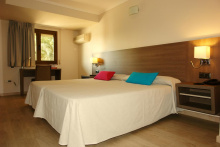
Carcaixent claims to be the birthplace of commercial orange cultivation in Europe — the first organized orange groves were planted here in the 18th century. The surrounding landscape of citrus orchards stretching to the horizon gives you an idea of how thoroughly this one crop has shaped the region.
The town has basic services. The walking through this part of Valencia province is flat and easy, through endless citrus groves and rice paddies.
La Pobla Llarga is a small agricultural town in the Ribera Alta comarca. No notable pilgrim services beyond a few bars. The camino passes through quickly on the way to Manuel and the approach to Xàtiva.
Manuel is a small town in the Ribera Alta. Basic services are available — bars and a supermarket. The town is unremarkable for pilgrims but serves as a waypoint on the approach to Xàtiva, which is now close. The landscape is flat — orange and citrus groves in every direction.
Torre de Lloris is a tiny hamlet between Manuel and Xàtiva. No services. The mountains ahead — including the dramatic ridge of Xàtiva's castle — are beginning to dominate the skyline. You're leaving the flat coastal plain behind.
Xàtiva deserves a night and an exploration. The castle is one of the most impressive in the Valencian Community — a double fortification stretching along the ridge above the town with panoramic views that on clear days reach the sea. The climb up is steep but worth every step.
The old town below the castle is a pleasure to wander, with narrow streets, handsome churches, and the Colegiata Basílica de Santa María. The Museo del Almodí, in a former grain exchange, has a good collection that includes a famously upside-down portrait of Felipe V — hung that way by the townspeople as punishment for burning their city in 1707 during the War of Spanish Succession.
Xàtiva has all services — restaurants, accommodation, supermarkets, pharmacy. It's the most interesting town between Valencia and Almansa.
Xàtiva is one of Europe's paper-making pioneers — the first paper mill in Europe may have operated here under Moorish rule. The town was also the birthplace of the Borja family (Italianized as Borgia), who produced two popes: Callixtus III and the notorious Alexander VI. The castle has been fortified since Iberian and Roman times, and the town was an important center under both Moorish and Christian rule. Felipe V burned Xàtiva after the Battle of Almansa in 1707 as punishment for supporting the Habsburg cause.
Accommodation in Xàtiva.
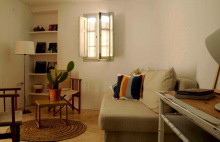
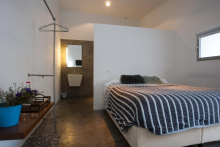
| Youth hostel Casa del Cigroner |
| Aldomar House Booking.com |
|
Novetlè is a small village between Xàtiva and Canals. No notable services. The camino passes through on quiet roads. You're in the transition zone between the Valencian coastal plain and the mountains of the interior.
Annauir is a tiny hamlet near Canals. No services. The walking through here is on quiet roads between agricultural plots — a brief passage between Xàtiva and Canals.
Aiacor is a small village on the outskirts of Canals. No services. You're approaching Canals now, where the connection to the Borgia family — one of history's most powerful and controversial dynasties — becomes concrete.
Canals is the birthplace of the Borja family, later known as the Borgias, who rose from this small Valencian town to dominate Renaissance Rome. The Torre dels Borja — a medieval tower in the center of town — marks the family's origins. It can be visited on special days; check at the ayuntamiento.
The town has basic services — bars, shops, a pharmacy. After Canals, the camino begins climbing into the mountains separating Valencia from the Castilian meseta. The flat coastal walking is over.
The Borja family originated here before rising to become one of the most powerful families in Renaissance Europe. Alfons de Borja became Pope Callixtus III in 1455, and his nephew Rodrigo became Pope Alexander VI in 1492 — the pope famous for his political machinations, patronage of the arts, and infamous personal life. The family name was Italianized to Borgia, and their legacy, for better and worse, shaped European history.
Vallada is a small town at the foot of the mountains separating Valencia from the Castilian meseta. The ruins of a castle sit on the hillside above — visible but requiring a steep climb to reach. The town has basic services including bars and a small shop. The landscape is changing: the lush citrus groves are behind you, replaced by drier, more rugged terrain.
Accommodation in Vallada.
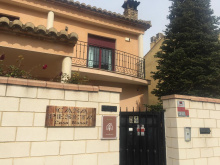
| Albergue Turístico Paraje de las Ermitas 45 |
| Casa Rural Casa Peseta Booking.com |
|
Mogente (Moixent in Valencian) is a small town known for the Bastida de les Alcusses, one of the most important Iberian archaeological sites in Spain. The hilltop settlement dates from the 4th century BC, and the famous Guerrer de Moixent — a small bronze warrior figure — was found here. It's become the symbol of the town.
Basic services are available. The town sits in increasingly arid, mountainous terrain as the camino approaches the border with Castilla-La Mancha.
The Bastida de les Alcusses was a fortified Iberian settlement occupied in the 4th century BC. The site was destroyed suddenly — possibly by fire during a conflict — and the inhabitants appear to have fled, leaving behind a remarkable collection of artifacts. The Guerrer de Moixent, a 7-cm bronze figurine of an Iberian warrior on horseback, is the most famous find and is now in the Museo de Prehistoria de Valencia.
Accommodation in Mogente - Moixent.
La Font de la Figuera is the last town in the Valencian Community before crossing into Castilla-La Mancha. It has basic services — bars, a small shop, accommodation. Stock up and rest here, because the next stretch to Almansa is 27 km with no intermediate services. Plan your water accordingly, especially in summer when temperatures on the meseta can be brutal.
The town sits at a natural mountain pass that has been a crossing point between the Mediterranean coast and the interior for millennia.
From La Font de la Figuera to Almansa there are 27 km and no intermediate places. Carry enough water and food — this is exposed, arid terrain with no shade in summer.
Accommodation in La Font de la Figuera.
| Municipal Pilgrims’ Hostel |
| Hostal Rural Amable ⭑⭑ |