Viana do Castelo
Camino Portugues
Viana do Castelo's trading wealth has left the town with a collection of notable buildings that punches well above its weight. The Se Cathedral, built in the 15th century, has a fortified facade that makes it look more like a defensive tower than a church. The Castelo de Santiago da Barra, near the river mouth, is a proper star-shaped fortress that saw action against pirates and rival navies for centuries.
The church you shouldn't miss is the Misericordia of Viana do Castelo. From the outside it's easy to walk past, but inside the combination of gilded woodwork and azulejo tiles covering every surface is extraordinary. The contrast between the modest exterior and the explosive interior makes it one of the best surprises on the Coastal route.
For the best view of the town and the entire Lima estuary, take the funicular up to the Santuario de Santa Luzia. It costs 3 euros round trip and deposits you at the foot of a massive neo-Byzantine basilica crowned by a Sacred Heart statue. The panorama from the terrace -- river, ocean, rooftops, mountains -- is worth considerably more than the fare. You can climb to the dome for an even higher viewpoint.
Back in the center, the Praca da Republica forms the social heart of town, anchored by the 16th-century Misericordia fountain and surrounded by cafes. The Gil Eannes, a former hospital ship that served Portugal's cod fishing fleet in the North Atlantic for decades, is permanently moored in the harbor and now serves as a museum and hostel. It gives you a visceral sense of just how hard the cod fishing life was.
Viana is also known for its traditional gold filigree jewelry, a craft that dates back centuries and remains very much alive in the workshops around town. You'll see the distinctive heart-shaped Coracao de Viana pendants in every jeweler's window.
In late August the Festas de Nossa Senhora da Agonia take over the town for three days. It's a romeria in honor of the Virgin of Agony, the patron saint of fishermen heading out to sea, and it combines religious processions with folk dancing, fireworks, and a general enthusiasm that draws visitors from across the region. It's one of the largest and most colorful festivals in northern Portugal.
Until 1848, the town was known as Viana da Foz do Lima, reflecting its position at the mouth of the Rio Lima. It was an important shipping center and critical port of entry during Portugal's Age of Discovery, and later became the country's second-largest center for the cod trade. The bacalhau fleet operated from here for generations, and the Gil Eannes hospital ship -- now a museum in the harbor -- is a tangible remnant of that era.
The town's strategic position at the river mouth attracted its share of conflict. The Castelo de Santiago da Barra was built and repeatedly expanded to defend against pirate raids and naval incursions, and the Se Cathedral's fortified appearance reflects the same defensive anxiety.
Leave the centro historico of Viana do Castelo from the main square. Head north from the fountain (keep the length of the square to your left) and follow the pedestrianized and tree lined street (the Passeio das Mordomas da Romaria) to the first intersection. Turn left there to follow in the same direction as traffic along the Rua Candido Dos Reis/Luis do Rego. The road ends at the Park and Garden of Dom Fernando, turn right and at the next intersection keep as straight as possible to what looks like a dead end road. Arrows here will direct you down steps and underneath a busy avenida.At the top of the stairs on the other end keep going straight (you will have turned right just before climbing the stairs). DO NOT follow this road all the way to the busy avenida. Instead, turn left uphill and against traffic along the first street. It is signed as a dead end road. Follow it to the underpass.As you exit the underpass you will be in a more residential neighborhood. Turn left at the first street which is directly in front of you, the Rua Dom Moisés Alves de Pinho. From here you continue straight for several kilometers to leave town.The way passes through several narrow streets and cobbled lanes but is well marked. The Quinta da Boa Viagem is the next obvious landmark in Areosa.
Accommodation in Viana do Castelo.
| Pousada de Juventude - Viana do Castelo 23+*€ 40 Booking.com |

|
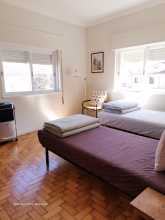
| Alex Point - Guest House 25-29*€ 6 Booking.com |
|
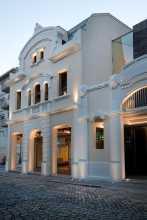
| Hotel Fábrica do Chocolate ★★★★ Booking.com |
|
| Hotel Calatrava ★★ Booking.com |

|
| Hotel Do Parque ★★★ Booking.com |

|
| Albergue de Peregrinos São João dos Caminhos 12€ 26 |
| Albergue de Santa Luzia 20-40€ 38 Booking.com |

|
Comments