Santiago de Compostela at the end of the Caminho da Geira
Caminho da Geira e dos Arrieiros
Colexiata de Santa María de Sar
⇣
1.30
⇣
Santiago de Compostela at the end of the Caminho da Geira
⇣
0.00
Welcome to Santiago. If you've walked the Geira from Braga, you've followed one of the oldest and least-traveled routes to Compostela — an ancient Roman road through Portugal's only national park, across a mountain border, and through the quiet heart of Galicia. Few pilgrims walk this route, and you've earned your arrival.
Your pilgrim business starts at the Pilgrim's Office. To get there from Plaza Obradoiro, face the Parador (the building on your left if you're facing the cathedral) and look for the road that goes downhill to the left. Halfway down you'll pass the public restroom, and at the next street turn right. The office is at the end of that road. If you're arriving in high season, be prepared for a queue.
The cathedral is the single largest attraction in Santiago and for good reason. Both inside and out it presents countless treasures — too many to list, but the highlights follow.
Start in front of the cathedral at Plaza Obradoiro, kilometer zero. A shell and plaque mark the spot in the center of the plaza. The Obradoiro facade is the most majestic and most photographed face of the cathedral — its 18th-century baroque design replaced the earlier Romanesque entrance. Behind this facade lies the Pórtico de la Gloria, Maestro Mateo's 12th-century sculptural masterpiece that was the original front of the church.
Inside, you can visit the crypt and embrace the bust of Santiago. The best time is early morning before the crowds arrive. The botafumeiro — quite possibly the largest thurible in the Catholic Church — is swung across the transept by a group of men called the tiraboleiros. Ask at the Pilgrim's Office for the current schedule.
Around the cathedral, four plazas each reveal a different face. Plaza de Inmaculada (also called Azabache) faces the Monastery of San Martín Piñario. The Puerta de las Platerías (Plaza Platerías) is named for the silversmiths whose shops still line the stairs below it. Plaza de Quintana holds the Puerta de Perdón — the Holy Door — with its carvings of 24 saints and prophets. In the shadows of Quintana, look for the hidden pilgrim, visible only at night.
The Monastery of San Martín Piñario is enormous — three cloisters — and you'll find yourself walking past it repeatedly on the north side of the cathedral. Its church facade is curiously below street level: the Archbishop decreed that no building should exceed the cathedral's height, so the architects simply dug down rather than compromise the design.
San Fiz de Solovio, near the Mercado de Abastos, is the oldest building site in Santiago. This is where the hermit Pelayo was praying when the lights led him to rediscover the bones of Santiago. The current church isn't the original, but excavations have revealed foundations and a necropolis dating to the 6th century.
The Mercado de Abastos is worth a wander for lunch. The vendors are second, third, or fifth-generation market operators, and the experience is quintessentially Galician — functional rather than flashy, excellent rather than showy.
Santiago has all services. If you're arriving in high season, book accommodation in advance — pilgrim numbers regularly exceed bed capacity.
If you're arriving in high season, book accommodation in advance. Albergue capacity has grown in recent years but demand still exceeds supply during peak months. The Pilgrim's Office queue can be long — arrive early or late to avoid the worst of it.
The Feast of Saint James (July 25) is celebrated with a full week of music and festivities. On the evening of July 24th, a fireworks display lights up Plaza Obradoiro. The best views are from Obradoiro itself or from Alameda Park. In Holy Years — when July 25th falls on a Sunday — the celebrations are especially elaborate and the Holy Door in Plaza Quintana is opened.
Santiago de Compostela grew around the reputed tomb of the Apostle James, discovered in the early 9th century. The city became one of the three great pilgrimage destinations of medieval Christendom, alongside Rome and Jerusalem. The cathedral was built and rebuilt over centuries — the current structure is primarily Romanesque (12th century) behind a baroque facade (18th century). The Pórtico de la Gloria, carved by Maestro Mateo and completed in 1188, is one of the supreme achievements of Romanesque sculpture.
Accommodation in Santiago de Compostela at the end of the Caminho da Geira.
| Albergue O Fogar de Teodomiro 19+€ 24 Booking.com |

|
| Albergue SCQ 21+€ 24 Booking.com |

|
| Albergue SIXTOS no Caminho 18-35€ 40 Booking.com |

|
| KM. 0 26+€ 55 Booking.com |

|
| Blanco Albergue 18+€ 20 Booking.com |

|
| Albergue La Credencial 19+€ 36 Booking.com |

|
| Albergue La Estación 20-30€ 30 Booking.com |
|
| Albergue Porta Real 21+€ 20 Booking.com |

|
| Albergue Meiga Backpackers 16+€ 30 Booking.com |

|
| Albergue Seminario Menor en Santiago de Compostela 17€ 199 Booking.com |

|
| Albergue Mundoalbergue 20+€ 34 Booking.com |

|
| Albergue Santo Santiago 14-18€ 40 Booking.com |

|
| Albergue The Last Stamp 19-25€ 62 Booking.com |

|
| Albergue Azabache 20+€ 20 Booking.com |

|
| Albergue La Estrella de Santiago 15+€ 24 |

|
| Albergue Linares 18+€ 14 Booking.com |

|
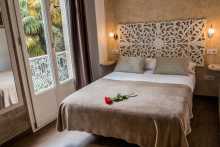
| Pensión Casa da Balconada Booking.com |
|
| Pensión Pazo de Argra ★ Booking.com |

|
| Hospedería San Martín Pinario ★ Booking.com |

|
| Albergue-Hotel LoopINN 30+€ 48 Booking.com |

|
| Alameda Rooms Booking.com |

|
| Mapoula PR Boutique Booking.com |

|
| Albergue Fin del Camino 15€ 110 |

|

