Golegã
Camino Portugues
Golega is the horse capital of Portugal. The Lusitano breed — one of the oldest saddle horse breeds in the world — has been bred on the surrounding Ribatejo pastures for centuries, and the town celebrates the tradition with the Feira Nacional do Cavalo every November: ten days of equestrian competitions, bull-running, and celebrations that fill every bed within 50 km.
The Igreja Matriz has a spectacular Manueline portal that justifies a stop. In the square opposite, the photography museum and studio of Carlos Relvas occupies one of the most beautiful buildings in town — the entrance is on the street before the main square, not the one the arrows send you down. Relvas was a pioneering 19th-century photographer who built this elaborate glass-and-iron studio to pursue his art.
Services in town. The route out can be confusing — find your way to the front of the church and leave from there.
When entering Golegã, arrows indicate a right turn on the first street. DO NOT take that road. Instead, take the next. You will arrive in the same place (the main square and church), but you will get to see the impossibly beautiful building that is the Cphotography museum and studio of Carlos Revas.
Two horse fairs are held every November.
The Ribatejo's horse culture predates the nation of Portugal itself. The Lusitano breed descends from Iberian horses that have roamed this region since antiquity — the Romans called them the fastest horses in the known world. Golega's annual horse fair has been held since the 19th century and is now the most important Lusitano event in the world.
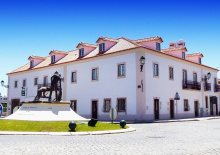
There are confusing arrows leading you the wrong way out of town by way of Rua Dom João IV. Ignore these and instead find your way to the front of the church. Walk around it via the square with the bullfighter (your left). Turn left on that road, and then right again. Follow the road all the way to, and through, an intersection with the N243.
Comments