Aire-sur-l'Adour
The Vía Podiensis
Aire-sur-l'Adour is a proper town with roughly 6,000 inhabitants and full services: hotels, gites, restaurants, supermarket, pharmacy, ATM, hospital. It's also where you cross from the Gers into the Landes department. The Adour River divides the town, with the center on the left bank clustered around the Cathedrale Saint-Jean-Baptiste.
The real draw is up on the Mas hill: the Eglise Sainte-Quitterie, a UNESCO World Heritage site since 1998. Built in the late 11th century on the remains of a Roman temple dedicated to Mars, this church was transformed into Gothic style in the 14th century. The Romanesque choir retains eight decorated capitals with biblical scenes and fantastical creatures. But the treasure is in the crypt, restored between 2016 and 2018: a 4th-century white marble sarcophagus from Saint-Beat in the Haute-Garonne, 2.12 meters long, carved with scenes from the Old and New Testaments -- the dream of Jonas, the sacrifice of Abraham, Daniel in the lion's den. The crypt also contains 14th-century wall paintings and reliquaries.
The town's markets (Tuesday and Saturday mornings) are excellent, and Aire is famous for its foie gras trade -- a vast octagonal grain hall from 1855 and a covered foie gras market from 1911 speak to that tradition.
Aire-sur-l'Adour has deep roots. Probably founded as a Celtic settlement called Atura, it fell to Crassus's troops in 56 BC. The Romans renamed it Vicus Julii. In the 5th century it became a Visigothic royal residence, and in 506 King Alaric II promulgated the Breviarium Alaricianum here -- a legal code governing relations between Visigoths and Gallo-Romans that remained in force until the 11th century. It's one of the most important legal documents of the early medieval period.
The legend of Sainte-Quitterie says she was a Catholic princess fleeing a forced marriage who was beheaded here by Arian Visigoths in 476. Where her head fell, a miraculous spring gushed forth. No historical sources confirm the story, but her veneration spread across southwestern France and northern Iberia, making her one of the most important regional saints for Camino pilgrims. A bishopric was maintained here for fifteen centuries, with the first bishop attested at the Council of Agde in 507.
Leaving Lectoure the GR65 enters the heart of Gascony, crossing the rolling hills of the Gers department through Armagnac country. The terrain is gentle but constant -- an endless sequence of small ascents and descents through vineyards, sunflower fields, and cereal crops. This section is rich in heritage: the UNESCO collegiate church at La Romieu, the walled village of Larressingle, the Gallo-Roman mosaics at Seviac, the treasure museum at Eauze, and Sainte-Quitterie's UNESCO-listed church at Aire-sur-l'Adour.
Services cluster in the larger towns -- Condom, Eauze, Nogaro, and Aire-sur-l'Adour -- with very little available in the hamlets between. Water can be scarce in the smaller villages during summer, so plan accordingly. The major resupply points are Condom and Eauze.
The landscape here is distinctly Gascon: think Armagnac vineyards (France's oldest brandy region, predating Cognac by 200 years), half-timbered colombage houses, bastide market squares, and course landaise arenas. You're in d'Artagnan country now.
Accommodation in Aire-sur-l'Adour.
| Accueil Communauté du Chemin Neuf 17€ 4 |
|
| Gîte La Chapelle des Ursulines 15€ 12 |
|
| Gîte d´étape La Maison des Pèlerins 18€ 15 |
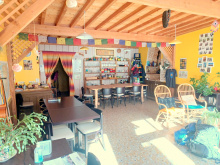
|
| Gîte d´étape Au Passage de l'Adour 25*€ 4 |
|
| Gîte Au Gré de l'Adour 23*€ 5 Booking.com |
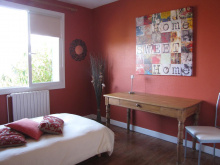
|
| Gîte-Hôtel de la Paix 15-18*€ 9 |
Comments