Santiago de Compostela at the end of the Camino Sanabrés
Camino Sanabrés
Camino de Invierno
Welcome to Santiago. There are a tremendous number of things to see and do in Santiago de Compostela. You're encouraged to stay for at least one full day extra to explore the web of streets, all of which seem to bring you back to the Cathedral.
Your pilgrim business likely starts in front of the Cathedral, at kilometer zero. A shell and plaque mark the spot in the center of Plaza Obradoiro.
If you're interested in receiving your Compostela, the certificate of completion, you'll need to visit the Pilgrim's Office. To get there from Plaza Obradoiro, face the Parador (the hotel on your left if you're facing the Cathedral) and look for the road that goes downhill to the left. Halfway down you pass the public restroom, and at the next street turn right. The office is at the end of that road.
The Cathedral is the single largest attraction in Santiago and for good reason. Both inside and out it presents countless treasures. The best time to visit is early in the morning before the crowds arrive, when paying a visit to the crypt and embracing the bust of Santiago can be done quietly.
The Cathedral - Plaza by Plaza
1. Plaza de Inmaculada (Azabache): As you enter the city, the first part of the Cathedral you pass is the Puerta de la Azabachería, facing the Monasterio de San Martín Piñario.
2. Obradoiro: From Azabache you pass under the Palace of the Bishop, adjoined to the Cathedral. The stairway leads to Plaza Obradoiro and kilometer zero. In the center is the last scallop shell, and you'll likely find pilgrims taking their shoes off for a photo. The Obradoiro facade is the most majestic of the Cathedral -- an 18th-century baroque design with massive glass panels that illuminate the Pórtico de la Gloria behind it. That Pórtico was the original front of the church, designed by Maestro Mateo six hundred years before the new facade.
3. Plaza Platerías: The Puerta de las Platerías is named for the silver craft still practiced in the shops below. Some of the stonework is replacement carvings -- the originals were damaged and moved to the Cathedral Museum, and unfortunately the original composition was forgotten, leaving a somewhat nonsensical layout. The Platerías fountain at the base of the stairs is the usual pilgrim meeting point, commonly called the horse fountain.
4. Plaza de Quintana: The large Plaza de Quintana holds the Puerta de Perdón. The Holy Door sits behind this facade. The carvings depict 24 Saints and prophets.
The botafumeiro, quite possibly the largest thurible in the Catholic Church, is swung across the transept by a group called the tiraboleiros. It has only come loose twice, and never in modern times. Check at the pilgrim's office for the current swinging schedule.
The Monasterio de San Martín Piñario is enormous -- three cloisters -- and you're almost always standing next to it on the north side of the Cathedral. The facade of the church descends rather than ascends to the entrance, because the Archbishop decreed no building should exceed the Cathedral in height. The architects didn't compromise on scale; they simply started lower.
San Fiz de Solovio is tiny compared to the Cathedral, but it's the oldest building site in Santiago. Find it near the Mercado de Abastos. San Pelayo, the hermit who rediscovered the bones of Santiago, was praying here when the lights called him. The current church isn't original, but excavations have revealed 6th-century foundations.
The Mercado de Abastos is a great place to wander for lunch. The architecture is strictly utilitarian and deeply Galician. The current buildings date from the 1940s but replace structures that stood for three hundred years. Many vendors are third, fourth, or fifth generation.
Alameda Park was once stratified by social class -- different paths for different stations. Now it's democratic and lovely. A Ferris wheel appears in summer, an ice rink in winter, and a massive eucalyptus tree overlooks the Cathedral year-round.
The Hidden Pilgrim hides in the shadows of the Plaza Quintana. He's only visible at night and might take a while to discover.
If you're arriving in high season, book accommodation ahead. There have been several additions to the albergue roster in recent years, but pilgrim numbers still exceed capacity during peak months.
The Feast of Saint James is celebrated with a full week of music and dance. Fireworks fill the Plaza Obradoiro on the evening of July 24th. The best views are from Obradoiro or from Alameda Park.
Accommodation in Santiago de Compostela at the end of the Camino Sanabrés.
| Albergue O Fogar de Teodomiro 19+€ 24 Booking.com |

|
| Albergue SCQ 21+€ 24 Booking.com |

|
| Albergue SIXTOS no Caminho 18-35€ 40 Booking.com |

|
| KM. 0 22+€ 55 Booking.com |

|
| Blanco Albergue 18+€ 20 Booking.com |

|
| Albergue La Credencial 19+€ 36 Booking.com |

|
| Albergue La Estación 20-30€ 30 Booking.com |
|
| Albergue Porta Real 21+€ 20 Booking.com |

|
| Albergue Meiga Backpackers 16+€ 30 Booking.com |

|
| Albergue Seminario Menor en Santiago de Compostela 17€ 199 Booking.com |

|
| Albergue Mundoalbergue 20+€ 34 Booking.com |

|
| Albergue Santo Santiago 14-18€ 40 Booking.com |

|
| Albergue The Last Stamp 19-25€ 62 Booking.com |

|
| Albergue Azabache 20+€ 20 Booking.com |

|
| Albergue La Estrella de Santiago 15+€ 24 |

|
| Albergue Linares 18+€ 14 Booking.com |

|
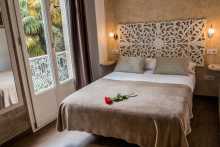
| Pensión Casa da Balconada Booking.com |
|
| Pensión Pazo de Argra ★ Booking.com |

|
| Hospedería San Martín Pinario ★ Booking.com |

|
| Albergue-Hotel LoopINN 30+€ 48 Booking.com |

|
| Alameda Rooms Booking.com |

|
| Mapoula PR Boutique Booking.com |

|
| Albergue Fin del Camino 15€ 110 |

|


Comments