Tomar
Camino Portugues
Tomar deserves at least a half-day. The Convento de Cristo, perched on the hilltop above the town, is one of the great monuments of Portugal — and a UNESCO World Heritage site since 1983. Built as the headquarters of the Knights Templar in the 12th century, it was expanded over four centuries and the result is a layered masterpiece of Romanesque, Gothic, Manueline, and Renaissance architecture.
The star is the Janela do Capitulo — the Chapter Window, a riot of Manueline stonework depicting ropes, coral, seaweed, armillary spheres, and the cross of the Order of Christ. It's the most famous window in Portugal, reproduced on everything from postcards to euro coins.
Inside the complex, the Charola — the original Templar rotunda, modelled on the Church of the Holy Sepulchre in Jerusalem — is the oldest section. The knights attended mass on horseback here, riding their horses into the circular nave.
Across the river, the Igreja de Santa Maria do Olival served as the Templar mother church and pantheon — many Grand Masters are buried here. The Sinagoga de Tomar, on Rua Joaquim Jacinto, dates from the mid-15th century and is one of the few pre-expulsion synagogues surviving in Portugal. It was converted to a prison, then a chapel, then a warehouse before being recognised and restored as a Jewish museum.
The Mata Nacional dos Sete Montes, the woodland park adjacent to the Convento, is a welcome respite on a hot afternoon. Services are plentiful in the town centre.
Tomar's history is inseparable from the Templars. Gualdim Pais, the fourth Grand Master of the Order in Portugal, founded the town and castle in 1160. The Templars defended this stretch of the Tejo against Moorish counter-attacks and were rewarded with vast landholdings across central Portugal.
When Pope Clement V dissolved the Templars in 1312 under pressure from Philip IV of France, the Portuguese king Dinis I simply renamed them. The Order of Christ inherited the Templar properties, personnel, and mission — many of the same knights continued serving under the new name. Prince Henry the Navigator later became the Order's administrator and used its wealth to finance the Age of Discoveries. The cross of the Order of Christ — a red cross with splayed arms — flew on the sails of Portuguese caravels that reached Africa, India, and Brazil.
The Festa dos Tabuleiros, held every four years (next in 2027), fills Tomar's streets with processions of women carrying elaborate towers of bread and flowers on their heads — 30 loaves high, topped with a crown and the cross of Christ or a dove. The tradition may predate Christianity, linked to ancient harvest celebrations.
To leave town cross the river over the Marques do Pombal bridge (it is a single lane bridge with a pedestrian path, and you will be going against the car traffic). Turn left at the start of the Alameda, left again onto Joao dos Santos Simaos, and then right onto Avenida Doutor Egas Moniz.Just past the bullring turn left and then right slightly. Not far ahead you will pass the very prison-like (literally and metaphorically) Infantry Barracks.The road gives way to a country trail and in a short distance arrives at the locally renowned Ponte de Peniche.Keep straight at the junction after the bridge, and continue to cross under the IC9, keeping to your left after doing so. It is pleasant country roads through planted forests.At the first paved intersection (a four-way intersection 3km after passing under the IC9), turn right onto the road. Follow it to the first fork and veer right into Casais.
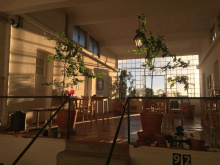
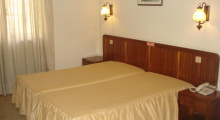
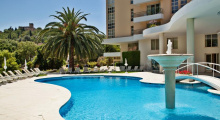
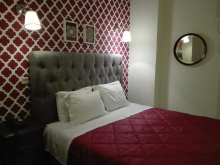
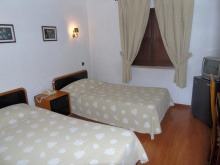
Accommodation in Tomar.
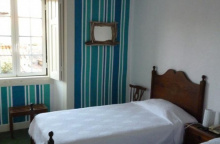
| Residencial União 30*€ 60 Booking.com |
|
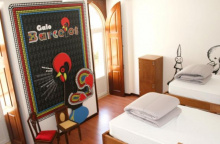
| Hostel 2300 Thomar 22-25€ 28 Booking.com |
|
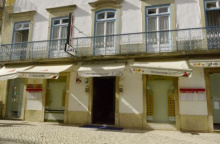
| Residencial Luz Booking.com |
|

Comments