Sevilla
Via de la Plata
Sevilla demands at least two extra days. It's Spain's fourth-largest city but the old town is walkable, and the density of what's worth seeing makes rushing through a waste.
Start at the Cathedral — the largest Gothic church in the world, built between 1401 and 1506 on the site of the main mosque. The builders' stated ambition was to construct something "so beautiful and so grand that those who see it finished will take us for mad." They succeeded. The interior is cavernous, the retablo mayor is the largest altarpiece on earth, and Columbus's tomb is carried aloft by four bronze figures representing the kingdoms of Castile, Leon, Aragon, and Navarra. DNA analysis in 2024 confirmed the remains are his — ending a centuries-long dispute with Santo Domingo.
La Giralda, the bell tower, began life as the mosque's minaret. You ascend via ramps, not stairs — the muezzin rode a horse to the top. The views from the summit are the best orientation you'll get.
The Real Alcazar, a few steps south, is essential. Pedro I commissioned Mudejar craftsmen from Toledo, Granada, and Sevilla itself to build his palace in the 1360s, and the result is one of the finest examples of Mudejar architecture on the peninsula. It's still a working royal residence — the oldest in Europe. The gardens alone justify the visit. Together with the Cathedral and the Archivo de Indias next door, it forms a UNESCO World Heritage site.
The Metropol Parasol in the Plaza de la Encarnacion is the largest wooden structure in the world — locals call it Las Setas (the mushrooms). A walkway across the top gives you an aerial view of the rooftops. The Plaza de Espana, built for the 1929 Exposition, is the most photographed square in Andalucia. The Torre del Oro on the riverbank was built by the Almohads in the 13th century and served as an anchor point for a defensive chain stretched across the Guadalquivir.
If museums appeal, the Museo de Bellas Artes occupies a former convent and houses art from ecclesiastical properties dissolved by royal decree in 1835. The Museo del Baile Flamenco and the Convento de Santa Paula are also worth the visit.
Pick up your credential at the Cathedral's Parochial Office, the Amigos del Camino de Santiago en Sevilla offices in Triana, or at several backpacker hostels. Get two — the Plata is long and stamps fill up fast. The Amigos office can also advise on trail conditions, which matters during the rainy season.
In a major city the size of Sevilla you can always expect there to be a celebration of something going on, but the largest and most iconic one is the week of Semana Santa leading up to Easter. Reserve a room early.
Sevilla's position on the Guadalquivir — navigable to the sea — made it the gateway to the Americas. The Casa de Contratacion, established in 1503 by Queen Isabella, regulated all trade with the New World from here. Columbus sailed from nearby. Magellan's fleet departed the river in 1519; only the Victoria returned, completing the first circumnavigation of the earth.
Columbus is buried in the Cathedral. Ferdinand III, who took the city from the Moors in 1248, is buried there too. The city's NO8DO motto — visible on manhole covers, lampposts, and flags everywhere — dates from King Alfonso X, who was supported by Sevilla during his civil war against his son Sancho. The 8 is a skein of wool (madeja), making the motto "No me ha dejado" — she has not abandoned me.
CAMINO MARKERS: Be aware that there is no single official designation of the camino trail. Between Sevilla and Santiago, the camino is maintained by a number of local and regional governments, as well as by several ‘Amigo’ associations. Along the way, you will find yellow arrows, ceramic shell tiles (whose orientation may or may not be significant), bronze plaques embedded in the sidewalk, post-mounted street signs, striped trail markings, and privately made and installed signs. Seldom though will you find more than two of these in any given area and before long you will develop a sense of what to look for. When you cross from region to region, or when you enter a large city, be on the lookout for something new.The markings of the camino in Andalucia come in the form of hand-painted yellow arrows, blue and yellow stickers, and ceramic tiles bearing a shell. In the case of the shell, the tile is oriented in such a way that you should walk in the direction of the ‘hinge’, which is to say towards the point where all of the lines converge. Note that this is not always the case in other parts of Spain, but the Amigos in Sevilla have done a good job of installing them as such. The camino begins at the Cathedral and makes its way to the Río Guadalquivir to cross at the Puente de Isabel II. This is the first bridge north of the Plaza de Toros. Once over the bridge, you have entered the barrio of Triana.
Accommodation in Sevilla.
| Hotel Doña María ★★★★ 95+€ Booking.com |
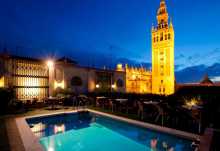
|
| Hotel Sevilla ⭑⭑ Booking.com |
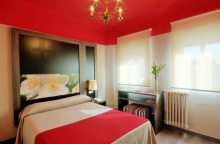
|
| Hotel Alfonso XIII ⭑⭑⭑⭑⭑ Booking.com |
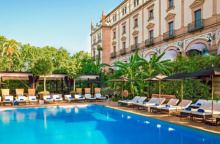
|
| Hotel Plaza ⭑⭑⭑ Booking.com |
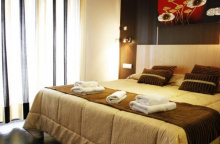
|
| Albergue Inturjoven Sevilla 15€ 300 Booking.com |
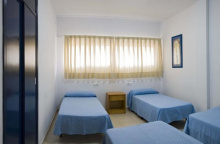
|
| Triana Backpackers 17€ 42 Booking.com |
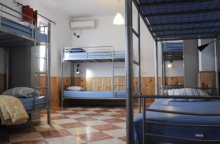
|
| Onefam Centro 18€ Booking.com |
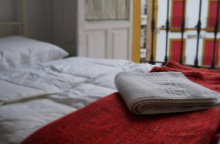
|
| The Nomad Hostel 18€ 38 Booking.com |
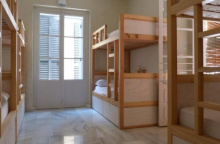
|
| The Spot Central Hostel Booking.com |
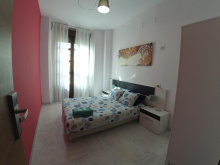
|
| La Banda Rooftop Hostel Booking.com |
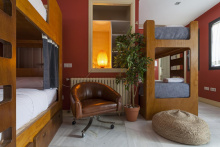
|
| Hospedería Convento de Santa Rosalía 25€ |
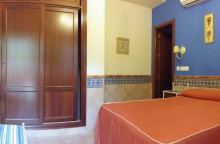
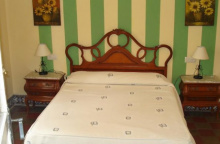
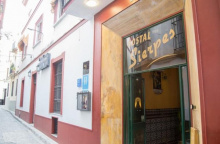
| Hostal Sierpes ⭑ Booking.com |
|
Comments