Alcuéscar
Via de la Plata
Alcuescar is a modest Extremaduran town with enough services to make it a practical stop -- bars, small shops, a pharmacy, and an albergue. There are no arrows in town since the camino enters along the road and leaves at the Casa de Beneficencia, so navigating the streets is a matter of common sense rather than waymarks.
The real reason to linger is the Basilica de Santa Lucia del Trampal, located 6 km south of town along a quiet road. This Visigothic church from the second half of the 7th century is the only one of its kind still standing in southern Iberia. It was lost for centuries, buried under vegetation, and only rediscovered in 1981. The floor plan is shaped like the Greek letter tau, with three independent chapels opening onto a transept through horseshoe arches. Original stone vaults survive, along with three domes supported by transversal horseshoe arches -- architectural features that wouldn't appear again until the Asturian pre-Romanesque period. The builders reused Roman and pre-Roman materials, which you'll spot in the walls. The site has an astronomical orientation that researchers are still studying. Admission is free, closed Mondays, and there's a small exhibition explaining what archaeologists found.
If you didn't detour to the Basilica on the walk in from Aljucen, consider the 6 km round trip from Alcuescar. It's one of the most significant archaeological sites on the entire Via de la Plata.
The Basilica de Santa Lucia del Trampal dates to the late Visigothic period, likely the second half of the 7th century. Built as a monastic church, it represents the most complex surviving Visigothic architectural structure in Spain. The use of Roman spolia (reused stone from earlier buildings) and its sophisticated vaulting system make it a crucial link between late Roman architecture and the Asturian pre-Romanesque that would follow. Its horseshoe arches predate the Moorish conquest, showing that this form was already part of the Iberian architectural vocabulary before Islam arrived.
The camino leaves town at a left turn just after the albergue. It is a paved road which gives way to a dirt road to follow through the countryside to Casas de Don Antonio.
Accommodation in Alcuéscar.
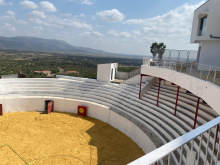
| Albergue Turistico Pampejo 20€ 33 |
|
| Apartamentos Rurales Casa Grande | 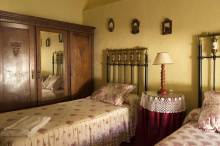
|
Comments