The approach to Nájera through its eastern industrial suburbs is uninspiring, but persevere — the old town, pressed against red sandstone cliffs on the west bank of the Río Najerilla, has genuine character.
The Monasterio de Santa María la Real is the highlight and well worth the admission fee. Founded in the 11th century when King García Sánchez III reportedly found a statue of the Virgin in a cave in the cliffs — along with a lamp, a bell, and a bouquet of lilies — the monastery houses the Panteón Real, the royal burial place of the kings and queens of Navarra, León, and Castile. Over 30 carved tombs line the nave, and that of Doña Blanca de Navarra is considered one of the finest Romanesque funerary sculptures in Spain. The cave itself is accessible from inside the church. The Claustro de los Caballeros, built between 1517 and 1528, combines late Gothic vaulting with Plateresque tracery in the arches — one of the finest cloisters in La Rioja.
The caves in the red sandstone cliffs above the monastery are accessible and worth the short climb for views over the town and river. Some of these caves are over 3,000 years old, carved out during the Celtic period for defense. They've served various purposes since.
Several albergues, hotels, and restaurants operate in the old quarter. A supermarket and all services are available. The riverfront promenade along the Najerilla makes for a pleasant evening walk.
The fiesta calendar is busy. San Prudencio, patron of La Rioja, is celebrated on April 28. San Juan and San Pedro run from June 24 to 30. The biggest celebration is Santa María la Real and San Juan Mártir in mid-September — expect bullfights, music, and processions through the old quarter.
The Fiesta del Pimiento Riojano, celebrating the Riojan pepper, falls on the last Sunday of May. San Antón is marked on January 17.
Nájera's name comes from the Arabic Naxara, meaning 'between cliffs' — an apt description once you see the red sandstone walls that hem in the old town. The city served as the capital of the Kingdom of Nájera-Pamplona from 923 to 1076, and it was during this period that it gave rise to the separate kingdoms of Navarra, Aragón, and Castile.
Sancho III el Mayor made Nájera his capital when Pamplona was under threat, and it was during his reign that the Camino was rerouted south from the mountain paths to its current course through the Riojan lowlands — a decision that shaped the Francés as we know it. He granted Nájera a charter, held the Cortes here, and established a market that helped fund the monastery.
The Monasterio de Santa María la Real was refounded in 1052 by García Sánchez III and handed to the Cluniac order by Alfonso VI. It survived Napoleonic occupation and the Mendizábal disentailment of the 1830s — barely — before being declared a national monument in 1889. Franciscans arrived at the end of the 19th century and have maintained it since.
The surrounding hills are also the legendary setting of the battle between Roland and the giant Ferragut, a story from the Codex Calixtinus. Ferragut, a Saracen giant, held the castle of Nájera until Roland discovered his only weakness — his navel — and killed him. The tale echoes David and Goliath and appears carved in capitals across the Camino, including at Navarrete's cemetery.
Leaving Nájera, the camino crosses the Najerilla and climbs through open farmland toward Azofra, about 7 km away. The walking is easy and mostly flat. Along the way, notice the modern gravity-fed aqueducts that irrigate the surrounding fields — they're an interesting piece of hydraulic engineering, with sections that pass beneath the road rather than over it.
Accommodation in Nájera.
| Albergue de Najera 7€ 48 |

|
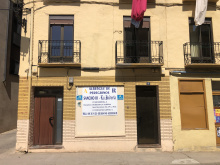
| Albergue de Peregrinos Sancho III - La Judería 13€ 15 |
|
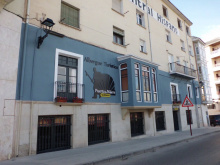
| Albergue Puerta de Nájera 15-20€ 32 |
|
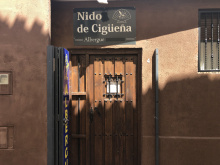
| Albergue Nido de Cigüeña 15€ 19 |
|
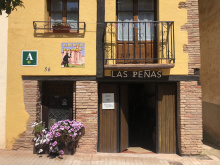
| Albergue Las Peñas 15€ 10 |
|
| Peregrino Najerino 14€ 22 |

|
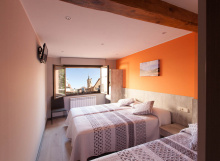
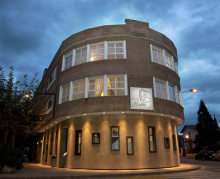
| Pension San Lorenzo Booking.com |
|

Comments