Cea
Via de la Plata
Camino Sanabrés
Cea is a bread town. That's not a quaint description -- it's the defining fact of this place. The Pan de Cea holds one of only four Protected Geographical Indication designations for bread in all of Spain, and the bakeries here have been turning out loaves for at least seven hundred years.
At its peak, Cea had around fifty bakeries. Today roughly seventeen remain, and every one of them follows the same strict rules: stone-ground flour, local water, hand-kneaded dough, and wood-fired granite ovens using only approved wood types. Every loaf weighs the same, has the same shape and golden color, and makes the same satisfying crack when you break it open. Over 300,000 loaves leave these ovens each year.
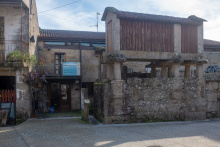
The old part of town is a tight knot of stone streets where every other building seems to have a legacy as a bakery. A few hórreos still stand between the houses. It's impossible to get truly lost here, though you may circle a few corners more than once. Buy a loaf before you leave -- the bread keeps well and you won't find anything like it for the rest of the walk.
The connection between Cea and bread goes back to the Monasterio de Oseira, the massive Cistercian monastery in the next valley. The monks developed the grinding and baking techniques; the town supplied the bread. King Sancho IV granted the monastery dispensation to sell its bread in the 13th century, and the tradition stuck.
The Festa da Exaltación do Pan de Cea takes place on the first Sunday of July in the Campo de A Saleta. You can taste the bread, visit exhibitors of Galician products with designation of origin, and on the day before, follow the Ruta dos Fornos -- a tour through the ancient bread ovens. It's designated as a Festival of Tourist Interest of Galicia.
The first historical reference to Cea's bakeries dates from the last third of the 13th century, tied to the Cistercian monastery of Oseira nearby. The monks baked and ground; the town of Cea supplied bread to the monastery and to travelers on the road. The location at a crossroads -- and on the pilgrimage route through Sanabria -- spread the bread's fame.
The IGP (Indicación Geográfica Protegida) was granted in 2004, formalizing what seven centuries of bakers already knew: this bread is something particular. The designation covers eighteen ovens in the municipality of San Cristovo de Cea.
The camino crosses the main road in Cea and heads uphill towards a sporting facility. Around the back side of the building, the camino splits into two distinct routes. The choice here is more consequential than the split leaving Ourense. The two options merge in Castro Dozón.
OSEIRA ROUTE - 18.4 km from split: The right route is the official camino and is longer than the Piñor variant. It passes through the village of Oseira with its massive monastery and albergue. It's better waymarked and more scenic. Turn right at the split. The paved road gives way to a track through the forest. About halfway to Pielas the camino rejoins a paved road.
PIÑOR ROUTE - 14.8 km: Shorter and more direct to Castro Dozón, but without an albergue along the way. Take care along the latter half as the waymarks can be difficult to find. It follows mostly rural tracks and country lanes through the hamlets of Porto de Souto (1 km), Cotelas (bar) (1 km), Piñor (bar, pharmacy) (1.6 km), Fontelo (0.8 km), Arenteiro (bar) (0.7 km), and O Reino (1.4 km). After O Reino the camino rejoins the N-525 and passes through Carballeda. At the far end of town, just before the exit sign, the camino turns left towards the motorway, passes beneath it, and begins the climb up to Castro Dozón.
Accommodation in Cea.
| Albergue de peregrinos de Cea 10€ 40 |
|
| Casa Mañoso Booking.com |

|
Comments