Oviedo at the end of the San Salvador
Camino de San Salvador
You've arrived. Oviedo is the reason the Camino del Salvador exists, and the Cámara Santa in the cathedral is the reason medieval pilgrims made this detour from León. "Quien va a Santiago y no al Salvador, visita al criado y no al Señor" — who goes to Santiago and not to the Salvador visits the servant and not the Master.
The Cathedral of San Salvador houses the Cámara Santa (Holy Chamber), a 9th-century pre-Romanesque structure containing some of the most venerated relics in Christendom. The Arca Santa (Holy Ark), according to tradition, contains relics brought from Jerusalem and North Africa to protect them from the Moorish conquest. Among them is the Santo Sudario — believed to be the cloth that covered Christ's face after the crucifixion. The Cruz de los Ángeles (808 AD) and the Cruz de la Victoria (908 AD) are masterworks of Asturian goldsmithery and symbols of the city and region respectively.
Beyond the cathedral, Oviedo rewards exploration. The pre-Romanesque churches on Monte Naranco — Santa María del Naranco and San Miguel de Lillo, both UNESCO World Heritage Sites — are among the most remarkable buildings in Spain. San Julián de los Prados (Santullano), closer to the city center, is the largest surviving pre-Romanesque church in the Iberian Peninsula, with original 9th-century frescoes.
The old town is compact and walkable, with the Plaza de la Catedral, the Plaza de Trascorrales, and the Plaza del Fontán forming a natural circuit. The sidrerías of the Calle Gascona (known as the Bulevar de la Sidra) are essential — sit down, order a bottle of sidra natural, and let the waiter pour it from height in the traditional Asturian style. For food, fabada asturiana is the signature dish — a rich bean stew with chorizo, morcilla, and lacón that will fortify you for whatever comes next.
The Salvadorana — the certificate of completion for the Camino del Salvador — can be obtained at the cathedral. Ask at the information desk or in the pilgrim office. If you're continuing to Santiago, most pilgrims either retrace their steps to León to rejoin the Camino Francés, or pick up the Camino Primitivo from Oviedo — the oldest pilgrimage route to Santiago, established by Alfonso II in the 9th century.
If you plan to continue to Santiago, you have two main options: return to León to rejoin the Camino Francés (by bus or train — about 2 hours), or begin the Camino Primitivo from Oviedo. The Primitivo is roughly 320 km to Santiago and is considered one of the more challenging and rewarding routes. The pilgrim office at the cathedral can provide information on both options.
San Mateo (around September 21) is Oviedo's main festival — a week of concerts, fireworks, and celebrations. The Martes de Campo (Field Tuesday), held the Tuesday after Easter, is an enormous outdoor gathering in the parks around the city. The Premios Princesa de Asturias ceremony in October brings international attention. Market: daily at the Mercado de El Fontán, Oviedo's beautiful covered market in the old town.
Oviedo was founded by monks Máximo and Fromestano in 761 AD and quickly became the capital of the Kingdom of Asturias — the small Christian realm that survived the Moorish conquest and from which the Reconquista would eventually expand. King Alfonso II (791-842) established the city as a major pilgrimage center, building the Cámara Santa to house relics brought from Toledo and other cities that had fallen to the Moors.
The cathedral's relics made Oviedo one of the three great pilgrimage destinations of medieval Christendom, alongside Santiago de Compostela and Rome. The Holy Ark, the Cruz de los Ángeles, and the Santo Sudario drew pilgrims from across Europe. The saying "Quien va a Santiago y no al Salvador" dates from this period and reflects the genuine importance attached to the Oviedo relics.
The pre-Romanesque architecture of Oviedo and its surroundings — Santa María del Naranco, San Miguel de Lillo, San Julián de los Prados, and the Cámara Santa itself — represents a unique artistic flowering. Built in the 9th century, these structures blend late Roman, Visigothic, and Carolingian influences into an architectural style found nowhere else. They were inscribed as UNESCO World Heritage Sites in 1985 and 1998.
In the modern era, Oviedo became the administrative capital of the Principality of Asturias. The city was heavily damaged during the Spanish Civil War — the university and parts of the old town were destroyed during the 1934 miners' uprising and again in 1936-37. The Cámara Santa was dynamited in 1934 but painstakingly reconstructed. The scars are mostly healed, but the history is recent enough to remember.
Arriving along the Camino del Salvador: shells and arrows will bring you right into the old quarters of Oviedo, passing a plaza and the beautiful Ayuntamiento building. Head for the cathedral — you've earned it. The Salvadorana certificate can be obtained at the cathedral's pilgrim information desk.
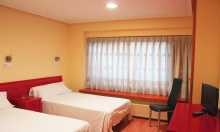
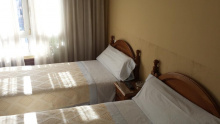
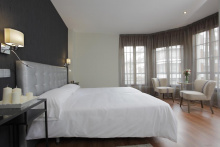
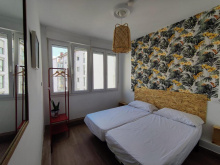
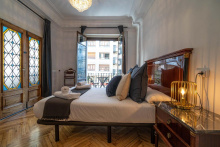
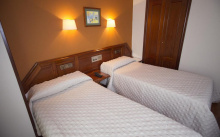
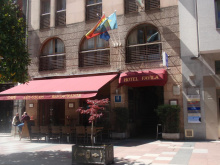
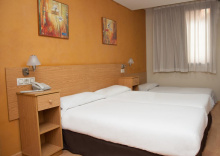
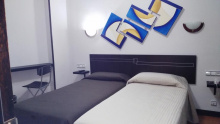
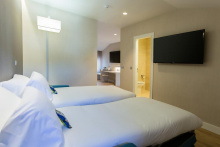
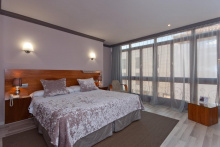
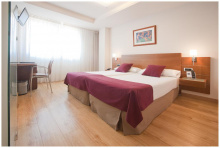
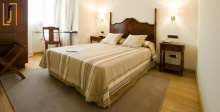
Accommodation in Oviedo at the end of the San Salvador.
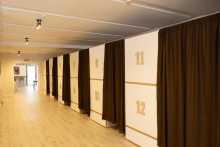
| Albergue-Hostel Gascona 27€ 24 Booking.com |
|
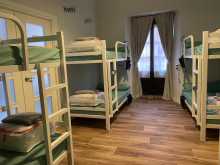
| La Hospedería Oviedo 20-25€ 10 Booking.com |
|
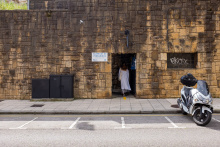
| Albergue de El Salvador de Oviedo 9€ 51 |
|
Comments