Irún sits on the Spanish bank of the Río Bidasoa, directly across from France. It's the starting point of the Camino del Norte, though you could just as accurately call it the first city of the Basque Country — the language, the food, and the politics all shift the moment you cross the river.
The Puente de Santiago is the traditional starting marker. From there, waymarking through the city is thin — be alert and don't hesitate to ask locals for directions. The train station (often abbreviated ff.cc.) provides a useful orientation point.
The churches are worth a look if you're spending the night. Nuestra Señora del Juncal holds the oldest statue of the Virgin in the region. The Ermita de Santa Elena is one of the city's oldest buildings. And the hilltop Ermita de San Marcial rewards the climb with sweeping views over the Bidasoa valley and the border.
Irún functions more as a departure point than a destination. Services are solid — supermarkets, pharmacies, ATMs, and transport connections — and most pilgrims pass through in a morning. If accommodation is full, Hondarribia across the bay has good alternatives.
The name Irún is often confused with Irúña (the Basque name for Pamplona), something to keep in mind when booking tickets.Irún is also the starting point for the Basque Interior Camino, which travels southwest to join the Camino Francés in Santo Domingo de la Calzada or Burgos. Do not confuse the two, you are heading northwest from Irún.
The fiestas of San Pedro and San Marcial, known collectively as Sanmarciales, are held at the end of June. San Marcos is celebrated on the 25th of April.
Irún was one of three major Roman outposts in Basque territory, alongside Irúña (Pamplona) and Iruña de Oca. Two significant battles took place at nearby San Marcial: in 1522, a few hundred local Basques defended the city against 3,000 mercenaries sent by the King of Navarra, and in 1813 Spanish troops and the Duke of Wellington defeated Napoleonic forces on the same hill.
Of the major Basque coastal cities, Irún was the least industrialized. Its economy ran instead on cross-border trade — since the 19th century, Spanish and French railways have operated on different gauge tracks, requiring all passengers and goods to transfer here.
Getting started in Irún is easiest from the train station or the municipal albergue, both are located in the Barrio San Miguel (though there is no church dedicated to the Saint).From the terminal head straight towards the dome of the nearby Iglesia San Gabriel and Santa Gema, passing the Correos (post office) along the way. Continue straight past the church to the first intersection with a traffic light, the Paseo Colon.From here you have two choices:1. The old town of Irún; turn right and over the tracks to get to most of the churches, parks, and hotels.2. The municipal albergue and the camino; turn left and you are officially on the camino. At the first roundabout the camino continues straight and heads under the overpass. Alternatively, turn right at the roundabout to get to the municipal albergue.When the opportunity to cross to the left-hand side presents itself do so; the camino turns left 500m ahead immediately after crossing the river.NOTE: If going to Hondarribia was your plan, keep going straight after the bridge. Once you have left the main road, the camino begins the climb, first on secondary roads and then on trails, to the Santuario de Guadalupe.
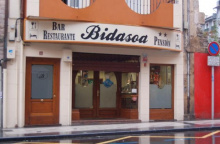
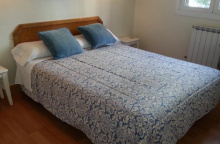
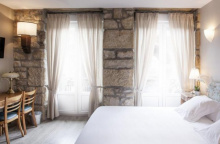
Accommodation in Irún.
| Albergue de peregrinos Jakobi Donativo€ 60 |

Comments