Bilbao
Camino del Norte
Bilbao is the largest city on the Camino del Norte and the one that's undergone the most dramatic transformation in living memory. In 1980, it was a grim industrial city of blast furnaces, polluted river water, and declining steel mills that had shed 60,000 jobs in fifteen years. Today it's a cultural destination that draws millions.
The catalyst was the Guggenheim Museum, designed by Frank Gehry and opened in 1997 on a former wharf along the Río Nervión. The titanium-clad building drew 1.3 million visitors in its first year — triple expectations — and triggered a wholesale reinvention of the city. The river was cleaned up, new bridges were built, public transport was modernized, and the post-industrial wastelands became parks and cultural spaces.
But Bilbao is more than the Guggenheim. The Casco Viejo (old town), on the right bank of the Nervión, is where the city began in 1300 when Don Diego López de Haro founded it. The original seven streets — Las Siete Calles — date to the 1400s and still form the grid of the old quarter. The Catedral de Santiago, the only cathedral in Spain consecrated to the apostle, has a 14th-century Gothic core and a Renaissance portico. The Plaza Nueva, a neoclassical square that opened in 1851, is ringed by pintxo bars on all four sides. The Basílica de Begoña overlooks the city from a hilltop — you'll pass it on the descent in, which is fortunate because most tourists have to make the climb up.
The Bilbao Fine Arts Museum, near the Doña Casilda Iturrizar Park, holds a collection that rivals many national museums. The Iglesia de San Nicolás, the Parroquia de San Antón (which appears with its adjacent bridge on Bilbao's coat of arms), and the Baroque Iglesia de los Santos Juanes round out the monuments.
For food, the Casco Viejo is where you want to be. The streets around the Plaza Nueva — particularly Calle del Perro, Jardines, and Santa María — are lined with pintxo bars that make San Sebastián's look like a warm-up. Order a zurito (small beer), point and eat, move on, repeat.
The EuskoTran tram follows the river and is the best way to see the new Bilbao if you're short on time. The Metro, designed by Norman Foster, is worth a ride for the architecture alone. All services are available. Transport connections to everywhere.
The main festival of Bilbao is known as La Semana Grande (though you will more likely see posters for ‘Aste Nagusia’); it celebrates the Assumption of Mary on the 15th of August. The 9-day celebration kicks off the following Saturday.
Though settled by Romans, modern Bilbao dates to 1300 and the founding charter of Don Diego López de Haro. Iron ore in the surrounding mountains drove industrialization on a scale unmatched in Spain — steel, machine engineering, and shipbuilding dominated for centuries. The city grew rich and grimy, its river lined with foundries and shipyards.
The decline began in the 1970s. Globalization undercut the steel industry, and by 1995 Bilbao had lost half its industrial employment. The response was radical: the city relocated its shipping and manufacturing to the coast, cleaned the Nervión, and invested in culture and infrastructure. The Guggenheim was the centerpiece, but the transformation ran far deeper — new bridges, a metro system, parks along the river, and a rebuilt waterfront. The 'Bilbao Effect' became a model studied by declining industrial cities worldwide.
The route through Bilbao is not singular. Indeed if you spend any time wandering off the camino (and you should) you are likely to find yellow arrows pointing a way. There is no wrong way, but there are many. There are essentially three different options ahead; all routes cross the river near the Iglesia de San Antón to leave the old town over the cities oldest and most frequently rebuilt bridge, the Puente de San Antón. Option 1: The Official Camino The official camino turns away from the river and crosses the city due west along one of its busiest Avenidas. As it nears the Basurto Hospital it splits, creating the second option below. To keep on the official camino requires you to cross the road to your left to follow a road uphill a short distance before crossing left again to get to the nearby stairs which will take you around the hospital and set you on a course to pass underneath the A-8. From here the camino begins to climb up to the municipal albergue, which is located well out of town on the hillside overlooking the city. The idea here is to go up and over the hillside. Winding down the other side you will pass under a highway and then over a river before climbing up another hillside. On the other side of this second hill you will descend into Barakaldo, passing several of its suburbs as well as the very large Bilbao Exhibition Center. The camino is well marked and winds its way through the center of Barakaldo. It will eventually bring you to a riverside pedestrian path. Not far ahead, where the path bends to the right, is a confusing split. There is an option at this point to cross the river (left, marked Sestao) and more or less avoid both Sestao and Portugalete altogether, by following a path along the river just to the south of both cities. The option is shorter and flatter and it follows a cycle path. Otherwise, the official camino bends right to follow the river and crosses into Sestao at a different bridge. Option 2: Through Bilbao but avoid the hills - A new route Possibly the least traveled option, this route follows the official camino as far as the hospital but keeps on the N-634. It is considerably flatter than the official camino, and only half as long. It is also recently waymarked so you may find it to be more commonly used by the time you get there. It essentially follows the west bank of the river all the way to Sestao, bypassing Barakaldo. Option 3: Direct to Portugalete on the east bank After crossing from the old town to the new town, simply follow the road that follows the curve of the river (which means turn right at the end of the bridge). You are essentially walking counterclockwise around Bilbao and will pass the Guggenheim Museum along the way. Beyond the museum you walk through a city park, and cross back over the river at the second bridge. Access to the bridge is elevated, so wind your way up the helical ramp. Once on the other side, wind back down to the road level and head towards the river. From there follow along the park path adjacent to the river. Where the park ends the camino turns to the right (north) at a large roundabout and then left onto the Calle Morgan. A few blocks later the road bends to the right and heads into a tunnel; at the same time the camino is above the tunnel, which is obvious when you see it. At the next road it turns left and then right again, taking you around a large sports complex. Before long you will arrive at another busy road and turn left. From that turn it is a more or less straight path all the way to the Viscaya Bridge over the river and into Portugalete. This last section follows close to the river and passes through several industrial parks; these are perhaps the only downside to this route. The bridge over the river into Portugalete is probably the highlight of the route. The locals call it the hanging bridge (puente colgante) and it is the first of its kind ever to be built, a distinction which earned it a UNESCO World Heritage Site designation. It operates every 8 minutes.
Accommodation in Bilbao.
| Albergue de peregrinos de Zabalbide Donativo€ 60 |
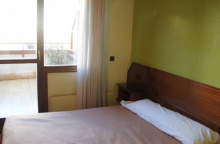
| Albergue Moon Hostel Bio 10€ 92 Booking.com |
|
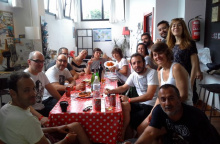
| Albergue Bilbao Akelarre Hostel 18€ 30 Booking.com |
|
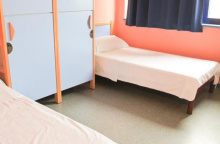
| Bilbao Hostel 19*€ 142 Booking.com |
|



Comments