Santa Marta de Tera
Via de la Plata
Camino Sanabrés
Stop here. Even if you're tired, even if you're behind schedule, stop. The Romanesque Iglesia de Santa Marta is the single most important piece of art on the entire Camino Sanabres, and it takes fifteen minutes to appreciate.
Around the back of the church, beside the south doorway, is the oldest known sculpture in stone of the Apostle Santiago depicted as a pilgrim. He carries a scrip and a staff, the classic pilgrim pose, carved in the mid-12th century. This image became so famous that it was used as the model for the 1993 Spanish 5-peseta coin. You've probably seen reproductions of it. Here's the original.
But the church has another trick. If you happen to be here on March 21st or September 23rd -- the spring and autumn equinoxes -- join the crowd to observe the illumination of a carved capital inside the church. As the sun aligns with an opening in the apse, a beam of light falls precisely on the carved scene. It's one of those moments where medieval engineering and faith intersect in a way that still gives you pause.
The church itself dates from the late 11th century and has a Latin cross plan with a single nave. The exterior carvings are exceptional -- look for the capitals on the doorways, each one telling a story. There's a small bar near the church but services are otherwise limited. Most pilgrims stay in Santa Croya just up the road, or press on toward Calzadilla de Tera.
The equinox illumination events on March 21st and September 23rd draw visitors to the church to watch sunlight align with the carved capitals.
The monastery at Santa Marta de Tera may date as far back as 1077. The current church was built in the late 11th to early 12th century in Romanesque style, with a Latin cross plan and a single nave. Its sculptures are its greatest treasure -- the Santiago Peregrino figure on the south doorway, dated to the mid-12th century, is considered the oldest stone sculpture of Santiago depicted as a pilgrim. The image became so iconic that it appeared on the 1993 Spanish 5-peseta coin. A companion sculpture of San Pedro flanks the same doorway. The equinox phenomenon, where sunlight illuminates a specific carved capital inside the apse, suggests the builders understood both architecture and astronomy.
The camino ahead turns westward and follows closely the Rio Tera as it runs between a string of villages. Shortly before Calzadilla de Tera the camino leaves the road to avoid a blind curve.
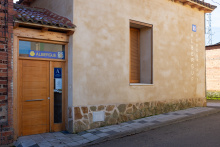
Accommodation in Santa Marta de Tera.
| Albergue de Peregrinos de Santa Marta de Tera 5€ 16 |
|
Comments