Cáceres
Via de la Plata
Caceres deserves your time. The old town was declared a UNESCO World Heritage Site in 1986 for its extraordinary blend of Roman, Moorish, Gothic, Renaissance, and Plateresque architecture, and it's considered the third best-preserved medieval centre in Europe after Prague and Tallinn. Go slow through it.
The camino enters through the Arco del Cristo, a 1st-century Roman gate and one of the few surviving openings in the original wall. Just uphill from the gate is the Casa/Museo Arabe, which offers a glimpse of domestic life for a wealthy Muslim family in the 12th century.
The first plaza you reach is the Plaza de San Jorge. The baroque church on the opposite end is the Iglesia de San Francisco Javier, commonly called the Iglesia de la Preciosa Sangre (Precious Blood), built by the Jesuits in the 18th century. Its tower can be climbed for commanding views over the rooftops.
From the Plaza de San Jorge the camino veers right, passing through a series of interconnected plazas to reach the Concatedral de Santa Maria. Built between the 15th and 16th centuries, it shares cathedral status with the one in Coria. If you don't make it inside, at least rub the toes of the bronze statue outside -- they belong to San Pedro de Alcantara, and their shine is a testament to the local belief that rubbing them brings good fortune in love.
The Palacio de los Golfines de Abajo sits nearby, a 15th-century Gothic fortress-palace where the Catholic Monarchs stayed when visiting the city. It functioned as the Golfin family's private residence for 500 years before reopening as a museum in 2015.
At this point, the Plaza Mayor is due west -- take the road to your left and through the archway. The plaza is lined with restaurants and overlooked by several medieval towers, the most prominent being the 12th-century Torre del Bujaco, a 25 m Arab-built watchtower on reused Roman ashlars that has become the city's symbol. Around 30 towers from the Islamic period still stand within the walls.
The camino follows a different path from the Concatedral, to the right, making a wide loop around the old town to pass the Iglesia de Santiago de los Caballeros, a 14th-century church built over an earlier 12th-century structure. The walled old town is encircled by 1,174 m of 12th-century Almohad walls -- compact enough to see in an afternoon, dense enough to reward a full day.
All services: hotels, pensions, restaurants, supermarkets, pharmacy, ATM, hospital. Book ahead in summer.
Caceres was founded by the Romans as Norba Caesarina in the 1st century BC. After Rome fell, it passed through Visigothic and then Moorish hands. The Almohads built the walls that still encircle the old town, and in 1229 Alfonso IX of Leon reconquered it definitively for the Christians. What followed was a golden age of construction. Rival noble families -- the Golfines, the Ovando, the Ulloa -- competed to build the most imposing fortified houses and towers. Queen Isabel I ordered many of the towers dismantled to curb the families' power, but enough survived to give the old town its distinctive skyline. The result is a city where Roman foundations support Moorish walls, which in turn are flanked by Gothic palaces and Renaissance facades -- layers of history stacked on top of each other with surprising coherence.
The best landmark for exiting Caceres is the bull ring, where the arrow visibility increases. Cross the main road at the bull ring and follow the signs to Casar de Caceres. You'll quickly find yourself leaving town along a divided colonnade with trees for shade. The pedestrian walk ends and the camino follows along the road to a large roundabout. Cross to the left and follow the roundabout clockwise. Be sure NOT to follow the N-521. You are looking for the smaller CC-38. Along the way keep an eye out for arrows which take you away from this busy road to enter Casar de Caceres along a much quieter path.
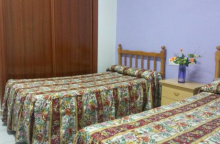
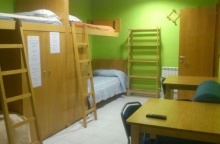
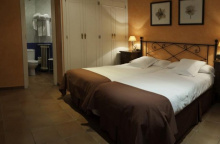
Accommodation in Cáceres.
| Albergue Municipal Ciudad de Cáceres 16€ 60 |
|
| Albergue turístico Las Veletas 16+€ 30 Booking.com |
|
| Pensión Zurbarán | 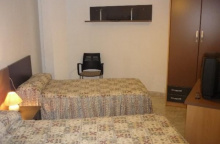
|
Comments