The last settlement in Castilla y León — a couple of houses and a small albergue. From here the boundary with Galicia is close, marked by a stone at the provincial line. The landscape is open mountain, with heather and gorse replacing the chestnut forest below.
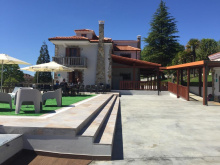
Accommodation in Laguna de Castilla.
| Albergue La Escuela de La Laguna 16€ 29 Booking.com |

|

You've entered Galicia — the final autonomous community on the Camino Francés. The boundary stone is modest, but the change is real. The language shifts (Galician appears on signs alongside Castilian), the landscape transforms (green, wet, enclosed), and the architecture evolves (granite replaces limestone, hórreos appear in every village).
Galicia is divided into four provinces. The camino enters through Lugo, crossing its mountainous southeastern corner before dropping into the valleys that lead to Santiago in the province of A Coruña.
The weather changes too. Galicia's Atlantic climate means more rain, more mist, and cooler temperatures than the meseta. The flip side is extraordinary greenness — the eucalyptus forests, the moss-covered stone walls, the constant sound of running water.
Galician cuisine is a revelation after the meseta. Pulpo á feira (octopus with paprika), empanada gallega (savory pie), lacón con grelos (ham with turnip tops), tetilla cheese, and the Albariño and Mencía wines are all ahead of you. The Galician tradition of serving a free tapa with every drink — common in Lugo and Santiago — will please your wallet.
The camino in Galicia is well-marked and well-maintained, with albergues at regular intervals. The final 100 km, from Sarria onward, is where the camino fills dramatically with pilgrims walking the minimum distance for a Compostela.
O Cebreiro (1,293 m) is where the Camino Francés enters Galicia, and the arrival — after the steep climb from Las Herrerías — is one of the great moments of the walk. On a clear day, the views stretch back over the Bierzo valley and the mountains of León. In the more typical mist, O Cebreiro materializes like a dream village from the cloud.
The village is famous for its pallozas — pre-Roman circular stone dwellings with thatched roofs that survived here into the 20th century. Several have been preserved as a museum-ethnographic exhibit, giving a vivid sense of how people lived in these mountains for millennia.
The Iglesia de Santa María la Real, a pre-Romanesque church dating to the 9th century, is one of the oldest on the Camino. It houses a chalice and paten associated with a Eucharistic miracle — the story tells that during a mass in the 14th century, bread and wine were transformed into visible flesh and blood. The relics are displayed in the church, and the event links O Cebreiro to the broader Grail tradition.
The village has several albergues, bars, and a small shop. The local cheese — queixo do Cebreiro — is a soft, mushroom-shaped cheese unique to this area. Buy it fresh from the shops here.
Arrive early if you want to enjoy the village before the day-trippers arrive from the parking lot below.
O Cebreiro has been a pilgrim stop since the earliest documented pilgrimage routes. The Benedictine monastery, founded in the 9th century, maintained a pilgrim hospital for centuries. The pallozas — pre-Roman Celtic structures — were continuously inhabited until the mid-20th century, making O Cebreiro one of the oldest continuously occupied settlements on the Camino.
The Eucharistic miracle is dated to the 14th century. The chalice and paten associated with it were later adopted by the Galician coat of arms, and their connection to Grail legends has been explored by scholars and romantics alike.
The Fiesta del Santo Milagro (Feast of the Holy Miracle) is celebrated on September 8-9. A romería takes place on the same dates.
From O Cebreiro, the camino continues along the ridgeline through Liñares and Alto de San Roque before descending toward Triacastela. The first few kilometers stay above 1,200 m, with sweeping views when the weather cooperates.
Accommodation in O Cebreiro.
| Albergue de Peregrinos O Cebreiro 10€ 104 |

|
| Albergue Casa Campelo 15€ 10 |


Liñares is a small mountain hamlet just beyond O Cebreiro, sitting on the ridgeline above 1,200 m. A bar and a basic albergue provide services. The walking here is along the open mountaintop, with views in every direction when the mist lifts.
Accommodation in Linares.
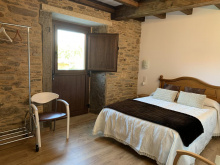
| Albergue Linar do Rei 17€ 20 Booking.com |

|

A bronze statue of a pilgrim leaning into the wind stands at the Alto de San Roque (1,270 m), perfectly capturing what it feels like to walk this exposed ridgeline. On a windy day — which is most days — the statue's posture makes complete sense.
The views from here stretch across the Galician mountains in every direction. The descent toward Hospital de la Condesa begins from this point.

Hospital de la Condesa takes its name from a medieval pilgrim hospital founded by a countess. The village is small — a bar and an albergue — but it sits in a pleasant mountain valley. The terrain begins to descend from the ridgeline here.


A small mountain village between Hospital de la Condesa and the Alto do Poio. A bar provides refreshment. The stone houses with slate roofs are typical of this part of the Galician mountains.

At 1,335 m, the Alto do Poio is the highest point on the Galician section of the Camino Francés. A bar-restaurant operates here, and a large stone monument marks the spot. The descent from here is long and steady, dropping over 700 m to Triacastela.
Accommodation in Alto do Poio.
| Albergue Bar Puerto 6€ 16 |

|

Fonfría ('cold fountain') sits on the descent from the Alto do Poio to Triacastela. The name is apt — at this altitude, the water from the village fountain runs cold year-round. A couple of albergues and a bar serve pilgrims. The village retains its mountain character: stone houses, slate roofs, the sound of cowbells.
Accommodation in Fonfría.
| Albergue A Reboleira - Casa Nuñez 14€ 50 Booking.com |

|

A tiny hamlet on the descent to Triacastela. No reliable services. The path drops through increasingly green countryside — the Galician landscape is asserting itself.

Another small hamlet on the descent. The vegetation thickens as you lose altitude: chestnut, oak, and the first eucalyptus trees appear.

A hamlet on the mountain road. No services. The descent continues through mixed forest.
A small village just above Triacastela. A bar may be open. The valley floor is visible below, and the walking eases as the gradient lessens.
Triacastela marks the bottom of the long descent from O Cebreiro and a natural stopping point. The village sits in a green valley, a dramatic contrast to the exposed mountain walking above. The name refers to three castles that once stood here — none survive.
The village has several albergues, bars, and restaurants. A small supermarket handles provisions. The atmosphere is relaxed and green after the mountain.
Historically, pilgrims quarried limestone from the hills around Triacastela and carried it to the kilns at Castañeda (further along the camino), where it was burned into the lime used in constructing Santiago's cathedral. It was a form of pilgrim labor — a practical contribution to the building of the destination they were walking toward.
The route splits here: one path goes directly to Sarria via San Xil (the shorter, hillier route), the other detours south through the Monastery of Samos before heading to Sarria. Both reach Sarria in roughly a day's walk.
Accommodation in Triacastela.
| Albergue de Peregrinos Aitzenea 13€ 38 |

|


From Triacastela, two routes lead to Sarria.
The San Xil route heads directly over the hills — shorter (about 18 km), with more climbing but better views. It passes through a string of tiny hamlets, most with no services. The terrain is rolling Galician countryside: green, enclosed, with narrow lanes between stone walls.
The Samos route detours south to visit the Monastery of Samos before turning east to Sarria — about 25 km total, with less climbing but more distance. The walking follows the valley floor through chestnut forest and farmland.
If you want to see Samos (and you should if you haven't seen a major Spanish monastery), take the longer route. If you've had enough of monasteries or want a shorter day, San Xil is the better choice. Both routes are well-marked.
A tiny hamlet on the San Xil route. No services. The name refers to an old iron forge.
A small hamlet on the San Xil route with a bar that may or may not be open. The path climbs through chestnut forest and small fields enclosed by stone walls — classic Galician mountain landscape.
Between here and San Xil you will pass a large fountain with a large scallop shell with a lot of graffiti and algae. Beyond that by two more kilometers is the Alto de Riocabo. You will also pass through San Xil de Carballo, with no services.
Accommodation in A Balsa.
| Albergue El Beso 13€ 16 Booking.com |

|
San Xil de Carballo gives this route variant its name. A tiny village with no reliable services. The terrain is hilly and green, with good views back toward the mountains you've crossed.
A hamlet on the San Xil route. No services. The path continues through wooded hillside.
You will not enter the village of Montán, but rather pass along the edge. While there is no fixed bar, there is a small picnic area with an on-again-off-again vending machine.
You will pass through Fontearcuda and Furela, no services.
A hamlet with a fountain (fonte) on the San Xil route. The water is reliable. No other services.
A small village on the San Xil route with a bar. The Iglesia de San Fiz has Romanesque elements. The path begins to descend toward Sarria.
A hamlet between Furela and Calvor on the San Xil route. No services. The descent toward Sarria continues.
Calvor has a bar and a small albergue on the San Xil route. The Iglesia de San Lorenzo has a simple Romanesque doorway. From here it's about 5 km to Sarria.
The camino does not go through Calvor, but rather passes near its Iglesia de San Estevo y San Pablo. To get to the church, turn left for a short detour once you leave Pintín. The church itself is nothing spectacular, but the site has been home to one building or another since two monks from Samos founded a church here in the 8th century. Also the view towards Samos is worth the detour.
Accommodation in Calvor.
| Albergue de Hospital de Calvor 10€ 22 |

|
A hamlet on the approach to Sarria via the San Xil route. No services. The outskirts of Sarria begin to appear.
Accommodation in San Cristovo do Real.
| Casa Forte de Lusío 10€ 60 |
A small settlement on the San Xil route, nearing Sarria. No services.
Pass several villages with no services: Lastres, Freituxe, and San Martiño do Real.
A hamlet on the San Xil approach to Sarria. No services. Sarria is close.
A small hamlet on the San Xil route. The walking is easy, descending gently through farmland toward Sarria.
A hamlet on the outskirts of Sarria on the San Xil route. A bar may be available.
The Monastery of Samos is one of the oldest and largest monasteries in Spain, its documented history reaching back to the 6th century. The complex is enormous: two cloisters (the Claustro Grande is one of the largest in Spain), a Baroque church, and monastic buildings that sprawl across the valley floor.
A community of Benedictine monks still lives here, and the monastery offers guided tours. The Claustro Grande has a 16th-century cloister with a cypress garden. The smaller Claustro de las Nereidas is older and more intimate. The church has Baroque frescoes and a fine organ.
A devastating fire in 1951 destroyed much of the monastery, and the restoration took decades. What you see today is partly original, partly rebuilt — but the scale and atmosphere remain impressive.
A couple of albergues and bars serve the village. The monastery itself offers accommodation. The setting — in a narrow green valley surrounded by chestnut forest — is beautiful.
Founded in the 6th century, Samos is one of the oldest continuously occupied monasteries in the Western world. It reached its peak of power and influence in the medieval period, controlling vast territories. The 1951 fire was catastrophic but the community survived. The Benedictine order continues to maintain the monastery.
Pass Foxos, and in Teiguín the camino splits again.It is possible to stay on the road all the way to Sarria, but the connection to Aguiada is recommended. Along the road to Sarria is 8.8km, via Aguiada 12.6km
Accommodation in Samos.
| Albergue de Peregrinos Monasterio de Samos Donativo€ 70 |

|
| Casa Rural Casas de Outeiro Booking.com |

|


A hamlet on the Samos route between the monastery and Sarria. No services.
A small hamlet on the Samos route. No services. The path follows the river valley toward Sarria.
A small hamlet on the Samos route near a river crossing. The restaurant Mesón O Vao serves meals and has become a popular stop for pilgrims on this variant. Beyond here the route approaches Sarria.
A hamlet on the Samos route. No services. The approach to Sarria is near.
A small village on the Samos route with a bar. The terrain is gentle farmland, and Sarria is visible ahead.

A hamlet on the Samos approach to Sarria. No services.
The remainder of the camino to Sarria is along the footpath adjacent to the road.
A hamlet on the approach to Sarria from the Samos route. The name — 'of the road' — confirms the ancient route.
Vigo de Sarria is the last hamlet before entering Sarria proper. A bar provides refreshment. From here you descend into the town.

Sarria is the most popular starting point on the Camino Francés after Saint Jean Pied de Port, for one simple reason: it's just over 100 km from Santiago, the minimum distance required to receive a Compostela. The result is a dramatic change in atmosphere — from Sarria onward, the camino fills with pilgrims who are walking the last section, and the trail becomes significantly busier.
The town itself is more appealing than its reputation for crowding suggests. The old quarter climbs a hillside above the Río Sarria, with the ruined castle at the top providing views over the surrounding countryside. The Monasterio de la Magdalena, run by the Mercedarian order, operates a large albergue and has a pleasant cloister. The Iglesia de El Salvador has a Romanesque tympanum.
The main street — the Rúa Maior — is lined with bars, restaurants, and equipment shops (useful for replacing worn-out gear for the final push). A supermarket, pharmacy, and all services are available. Multiple albergues and hotels serve the large pilgrim population.
The Pilgrim Office issues credenciales and stamps. If you're starting in Sarria, pick up your credencial here and get your first sello. You'll need at least two stamps per day from Sarria to Santiago to qualify for the Compostela.
Getting to Sarria: RENFE trains from Madrid and bus services from Lugo and other Galician cities.
Along the way between Sarria and Portomarin it is common to find beggars and buskers and the occasional scam artist soliciting your support and money and signature. Do your best to avoid becoming ensnared, the best method is to keep on walking. Also, you are advised to get your credential stamped at least twice a day between here and Santiago.
Sarria has served as a pilgrim town since the earliest days of the Camino. Alfonso IX of León, who was himself making a pilgrimage to Santiago, died here in 1230 — a fact commemorated in the town. The castle ruins and medieval bridge speak to the town's historical importance as a waypoint on the pilgrim road.
The camino exits town along the Rúa Maior in the old town and passes the Convento de la Magdalena. Take note that the camino actually turns left BEFORE arriving at the convent. It goes steeply downhill to the road, turns right, and soon crosses the río Celeiro on the Ponte Áspera. It follows along the river, and in the shadow of a super bridge before crossing the train tracks. The first climb of the day (excluding the stairs in Sarria) is ahead and passes through an ancient forest full of gnarly oaks and chestnut trees.
Accommodation in Sarria.
| Albergue A Pedra 14€ 23 Booking.com |

|
| Albergue Don Álvaro 15€ 30 Booking.com |

|
| Albergue O Durmiñento 10€ 41 Booking.com |

|
| Albergue Casa Peltre 12€ 22 Booking.com |

|
| Albergue Monasterio de la Magdalena 12€ 110 Booking.com |

|
| Alma do Camiño 13€ 100 Booking.com |

|
| Albergue Obradoiro 12€ 38 Booking.com |

|
| Albergue Puente Ribeira 12€ 30 Booking.com |

|
| PENSIÓN ALBERGUE MATIAS LOCANDA 10€ 40 Booking.com |

|
| Albergue Oasis 14€ 27 Booking.com |

|
| Albergue La Casona de Sarria Booking.com |

|


Vilei is one of the first hamlets outside Sarria, and the change in atmosphere is immediate. The Galician countryside closes in: narrow lanes between stone walls, hórreos (raised granaries) in every farmyard, eucalyptus and chestnut forest, and the constant sound of running water. This is what the last 100 km looks like.
A bar provides refreshment. The camino is well-marked with the distinctive Galician stone waymarkers.
Vilei and many of the small hamlets throughout Galicia have always been the agricultural heart of Galicia, working primarily in the dairy industry. Pilgrims come and go, and nothing for them changes much. These clusters of inhabited places are called caserios, and in many cases they number only a few houses and a small chapel.
Accommodation in Vilei.
| Albergue Casa Barbadelo 14€ 40 Booking.com |

|

Barbadelo has the Iglesia de Santiago — a small Romanesque church with a fine carved doorway that is one of the better examples of rural Romanesque architecture in Galicia. The church sits slightly off the camino but is worth the few extra steps.
A bar and a basic albergue serve the hamlet. The walking from here continues through rolling Galician countryside, passing through a succession of tiny hamlets.
Barbadelo, small as it is, once housed a monastery in 874. The current church dates from the 12th century and has several quality sculptures, including the animals carved into the north portal. It is 50m off the camino to your left, signed.
Accommodation in Barbadelo.
| A Casa de Carmen 15€ 20 |

|

A hamlet between Barbadelo and Mercado da Serra. No services. Stone walls, green fields, eucalyptus.

The name suggests a former market village. A bar may be open. The walking continues through gentle countryside.
A curious place for a medieval market, but that is exactly what this crossing of roads is known and named for.
The camino passes through the hamlets of Leimán, Peruscallo, Cortiñas, Lavandeira, Casal, and Brea. None have any services. The way is more gently rolling hills.
Between here and Morgade you may find, behind a fence on your right-hand side, a rather curious and grumpy ostrich. Ostrich meat is a growing industry in Spain, but this particular fella is the family pet.
Another small hamlet on the trail between Sarria and Portomarín. No services.
A hamlet with no services. The path winds through Galician farmland.
A hamlet on the trail. No services. The name means 'laundry place' — a reference to the stream.

A hamlet with a bar and a small albergue — welcome services on this stretch. The Casa Morgade has a good reputation.
Ferreiros ('blacksmiths') has a bar and an albergue. The Iglesia de Santa María has a simple Romanesque form. The village is one of the better-serviced hamlets between Sarria and Portomarín.
Beyond Ferreiros you will encounter the 100km marker. It is the single most vandalized object on the camino, changing from day to day as pilgrims leave their mark. From here on to Santiago the terrain has smoothed out, but do not be deceived. Although the height of the peaks has been reduced, the frequency with which you have to climb the smaller ones has increased.
Accommodation in Ferreiros.
| Albergue Casa Cruceiro 14€ 24 |

|

A tiny hamlet with no reliable services. The trail continues its gentle progress through Galician countryside.
Beyond Mirallos you will encounter the 100km marker. It is the single most vandalized object on the camino, changing from day to day as pilgrims leave their mark. From here on to Santiago the terrain has smoothed out, but do not be deceived. Although the height of the peaks has been reduced, the frequency with which you have to climb the smaller ones has increased.

A hamlet between Ferreiros and Portomarín. No services.
You will pass through Rozas and Moimentos, no services.
Accommodation in Pena.
| Casa do Rego 15€ 6 |

|
| Casiña de Campo Booking.com |

|


A hamlet near Portomarín. No services. The reservoir and bridge begin to come into view.
A small hamlet with a bar. From here the descent to the Miño reservoir and Portomarín begins.
Accommodation in Mercadoiro.
| Albergue Mercadoiro 12€ 36 |

|
A hamlet near Portomarín with views over the Belesar reservoir. The descent to the bridge steepens from here.
You will pass through Parrocha, no services.

A hamlet above the reservoir. The bridge across the Miño to Portomarín is visible below.
The last hamlet before the descent to the bridge at Portomarín.
The camino will soon bring you within sight of Portomarín. You will also pass through the town of Vilachá before beginning the rather steep descent into the valley of the río Miño and across the modern bridge to Portomarín.
The camino into town passes over the new bridge. The old bridge spends most of its time submerged beneath the river below but by the end of summer it emerges as the water level drops. Up the stairs and through the small chapel, you are almost into town. It is a bit more uphill still.
Portomarín has a strange history. The original town sat on the banks of the Río Miño until 1962, when the valley was flooded to create the Belesar reservoir. The entire town was relocated to higher ground, and the most important buildings — the Iglesia de San Nicolás and the doorway of the Iglesia de San Pedro — were disassembled, moved stone by stone, and rebuilt on the new site.
You cross the reservoir on a long modern bridge, and when the water is low in late summer the ruins of the old town emerge ghostlike from the lake bed — foundations, walls, the outline of the old bridge.
The Iglesia de San Nicolás, rebuilt on the hilltop, is a fortress-church with a rose window and crenellated roofline that looks more military than ecclesiastical. Inside, the Romanesque interior is impressive — the reassembly was expertly done. The doorway of the old Iglesia de San Pedro has been set into the wall of the new church.
The town has a pleasant central plaza, several albergues and hotels, bars and restaurants. Portomarín produces an aguardiente (grape spirit) with a strong local following. The main street has all basic services.
The terrain on both sides of Portomarín is hilly — you descend steeply to the bridge and climb steeply out the other side.
Be aware of high-speed traffic as you are required to cross back and forth across the main road.
The original Portomarín was an important river crossing on the Roman road and later on the pilgrim route. The Roman bridge and the medieval town were destroyed by the 1962 flooding, though the key monuments were saved. The relocation effort, while controversial, preserved the most significant architectural elements.
From the square simply head downhill along the colonnaded street and stick to it until you arrive at the main road. DO NOT keep going straight. Rather turn left and head back in the direction of the bridge into town. Before you get there arrows will direct you onto a different bridge over a small river that feeds the reservoir.
At the end of the bridge are two options: TURN RIGHT.
From here it is a steadily uphill march all the way to Gonzar, passing Toxibo with its hórreo along the way. After passing through a stretch of forest the camino returns to the main road and parallels it on a gravel track. This track crosses back and forth over the main road on several occasions. Be mindful of traffic here, particularly during the morning hours when the area can be thick with fog.
Accommodation in Portomarín.
| Albergue Ultreia Portomarin 14€ 14 Booking.com |

|
| Albergue Casa do Marabillas 16€ 6 Booking.com |

|

The climb out of Portomarín is steep. Toxibo is one of the first hamlets above the reservoir, with views back over the water. A seasonal bar may be open. From here the terrain is rolling Galician hills.
Gonzar has a bar and a small albergue — a practical stop after the climb from Portomarín. The Iglesia de Santa María is simple but has some Romanesque stonework.
The camino leaves along the road but departs from it quite quickly. You will find that it does this often; the arrows have been placed in a manner which keeps you as far from heavy traffic as possible.


A hamlet with the remains of a castro (pre-Roman hillfort) nearby. No services.
Shortly beyond the village, a mere 50m off the camino to your left, are the remains of the Iron Age castro that gives the town its name. It is seldom visited (there are no signs) but is worth an exploration. It can be found before the point where you meet the main road.
Shortly beyond the village, a mere 50m off the camino to your left, are the remains of the Iron Age castro that gives the town its name. It is seldom visited (there are no signs) but is worth an exploration. It can be found before the point where you meet the main road.

The name recalls a former pilgrim hospital. A bar may be open seasonally. The walking continues through rolling farmland.
When leaving Hospital de la Cruz it is important to pay close attention to the traffic. The camino crosses a large roundabout, goes over the highway, and then turns left. At this point, you are actually walking along the highway on-ramp, though only for a short distance. It turns right and continues the upward march towards Ventas de Narón.

Ventas de Narón is a small village with a couple of bars and a monument to a battle between Charlemagne's forces and the Moors — though the historical accuracy of Charlemagne ever reaching this far into Galicia is doubtful. The legend persists regardless.
The village sits below the climb to the Alto de Ligonde, one of the more noticeable hills on this section of the Galician camino.
The year 820 was an important one for Ventas de Naron, and for Christian Spain. For Ventas, it was the site of a battle between the Muslim and Christian forces. The Muslim forces aimed to expand their territory to the north and the Christians, led by the Asturian King Alfonso II the chaste, sent them back. For Christian Spain, it was also the year that the bones of our favorite Apostle were rediscovered. Not long after the very same Alfonso would become the first pilgrim (the primitivo), would verify the relics, would build a church to house them, and would set in motion a course of events that would see the remaining Muslim forces defeated.
Accommodation in Ventas de Narón.
| Albergue Casa Molar 14€ 18 |

|

The Alto de Ligonde is a modest summit on the route between Portomarín and Palas de Rei. A cruceiro (stone cross) marks the top. The views across the rolling Galician landscape are pleasant. No services.

Ligonde has a small albergue and may have a bar operating. A medieval cemetery next to the church is a reminder of the village's historical connection to the pilgrim route.
Locals say that the field on your right at the start of town is a pilgrim cemetery. There doesn’t seem to be any commemoration of that fact, or protection of the site either. Whether it is or is not a cemetery seems less important than the insight gained by remembering how dangerous a pilgrimage of this sort could be.
Accommodation in Ligonde.
| Albergue Fuente del Peregrino Donativo€ 7 |

|

A small hamlet with a bar and an albergue. The Iglesia de Santiago has a simple Romanesque form.
Eucalyptus: The Eucalyptus tree, indigenous to Australia, was brought to Galicia in 1865 for the construction trade. It proved to be a poor choice and is now used to produce paper (most of it is shipped to the mills in Portugal). The Galicians have a love/hate relationship with this invasive species and you will find the occasional message of “Eucalyptus Non!” sprayed on buildings. There are no natural controls for the tree, which grows fast, drives out local species (oak and chestnut), and which are extremely flammable during dry seasons.
Accommodation in Eirexe.
| Albergue de Eirexe 10€ 20 |

|
| Pension Eirexe |
A hamlet with a bar between Eirexe and the detour to Vilar de Donas.

A 1.5 km detour south of the camino leads to Vilar de Donas and the Iglesia de El Salvador — one of the finest Romanesque churches in Galicia and well worth the extra walking.
The church was the headquarters of the Knights of Santiago in Galicia, and it preserves remarkable 14th- and 15th-century Gothic frescoes on the interior walls. The stone tombs of knights line the nave. The church is a national monument and opens to visitors — check hours locally, as they can be limited.
The detour is well-signposted and rejoins the main camino without backtracking.
A hamlet between Portos and Palas de Rei. No services.
You will pass through Os Valos and Mamurria, no services.

A roadside bar-restaurant on the approach to Palas de Rei. Useful for an early breakfast or late stop.
From here the camino passes through more forests and nears the road at Rosario.

A hamlet on the outskirts of Palas de Rei.
Along the descent from here you will pass Os Chacotes, a recreational area with a log-cabin style hotel and sports facilities. At the entrance to Palas de Rei is the Iglesia de San Tirso, where a stamp is available. From there it is down a set of stairs into town.
Palas de Rei is a small but functional town that serves as the municipal center for the surrounding area. It has a good range of services: several albergues and hotels, bars and restaurants, a supermarket, a pharmacy, and ATMs.
The Iglesia de San Tirso has a Romanesque doorway. The town sits on a hilltop, and the camino passes through the center along the main street.
The name may derive from Palatium Regis (Royal Palace), suggesting a medieval royal residence. Today it's a practical stopping point rather than a destination, but the food is good and the facilities are solid.
From Palas de Rei, the camino enters its final stretch. Santiago is about 65 km ahead.
The origin of the name Palas de Rei, ‘Palace of the King’, is owed to the last Visigothic king to rule Spain. Witiza had a brief reign, from 700-709, and he was only 14 when he was anointed. The family ruled all of the Iberian peninsula from Toledo and it wasn’t until 701 that Witiza came to Galicia, likely to Tui; his migration was prompted by both a Byzantine invasion and the spread of the plague from Constantinople. His reign was short lived but his namesake village here on the camino remains. For the record, he was, in fact, a co-ruler alongside his father, but ‘Palace of the Half King’ lacked a certain flair.
You have now entered eucalyptus territory, and although there are patches of old oak forests to be found this non-indigenous species has taken over the landscape and has become a symbol of Galicia.
Accommodation in Palas de Rei.
| Albergue Os Chacotes 10€ 112 |

|
| Albergue Outeiro 14€ 57 Booking.com |

|
| Albergue A Casiña di Marcello 17-20€ 17 Booking.com |

|
| Hostel O Castelo Booking.com |

|

You've entered eucalyptus territory. Although patches of native oak forest survive, this non-indigenous species has taken over the Galician landscape. Love it or hate it (the locals are divided), the tall, fragrant trees will be your companions for much of the remaining walk to Santiago.
A hamlet with a small church and no reliable services. The path continues through eucalyptus and mixed forest.
The bar here opens at 7:30.
The Iglesia de San Xulián preserves some Romanesque stonework.
Near San Xulain the camino is undergoing a rerouting to accommodate the new highway connecting Santiago with Lugo. Most recently this meant walking across the unfinished highway. Changes are frequent and it is best to follow the detour signage.
Accommodation in San Xulian.
| Albergue O Abrigadoiro 15€ 17 |

|

A medieval bridge over the Río Pambre. The bridge is well-preserved and the setting, in a wooded valley, is pleasant. No services.
The bridge dates to the medieval period and was part of the pilgrim infrastructure maintained by local monasteries.

A hamlet between Ponte Campaña and Leboreiro. A small albergue and bar may operate. The walking is easy, through Galician farmland.


A hamlet with a bar that provides refreshment on the approach to Leboreiro.

Leboreiro is one of the more charming hamlets on this stretch. Sparsely populated but well-maintained, with stone houses and the small Romanesque Iglesia de Santa María de las Nieves. The tympanum over the doorway is worth a look.
The village has the first cabaceiro you'll encounter — a small woven structure with a thatched roof that serves the same purpose as the stone hórreos: keeping grain dry and away from vermin. Where the hórreo uses granite and raised posts, the cabaceiro uses woven branches and straw. Both solutions work; the materials just depend on what's available locally.
The church is surrounded by the familiar legend of the Virgin who moved in the night — a mysterious glowing spring appeared, and when the locals searched for the source they found a statue of the Virgin. A chapel was built to house it, but each night the statue returned to the spring. Eventually a church was built on the spring itself, which satisfied the Virgin. The story appears in similar form at dozens of churches across Europe.
Furelos has a Roman bridge, a church, and a bar — a satisfying combination. The bridge is small but genuinely ancient, its stones worn smooth by two millennia of traffic. The bar serves excellent tortillas.
The Iglesia de San Juan has an unusual crucifix depicting Jesus with one arm reaching upward rather than stretched to the side — a rare variation worth seeing.
The village and its pilgrim hospice were owned by the Hospitallers of San Juan in the 12th century. The bridge is Roman in origin, rebuilt in the medieval period.


Melide is the pulpo capital of the Camino. Although octopus has been on menus since O Cebreiro, it reaches its apotheosis here. The town's Thursday market meant that fresh seafood was shipped inland regularly, and the tradition stuck. Pulpo á feira — octopus boiled, sliced, dusted with paprika and coarse salt, drizzled with olive oil, and served on a wooden plate — is the dish. The Pulpería Ezequiel is the most famous purveyor, but several other pulperías compete vigorously.
Beyond the octopus, Melide is where the Camino Primitivo (the original route from Oviedo) joins the Francés. The town has a medieval core stretched along the road, shaped by centuries of pilgrim traffic. The Iglesia de San Pedro has Romanesque elements. The Iglesia de San Roque houses a small museum.
Multiple albergues and hotels, bars and restaurants, supermarket and pharmacy. The traffic through town can be dangerous, particularly on market days — follow the arrows carefully.
Melide is an ancient settlement at a natural crossroads. Despite its strategic importance since Neolithic times, it was never walled — an unusual vulnerability for a town of this significance. In medieval times, nearly all industry was tied to the Camino.
The camino leaves Melide through the town center — watch for arrows, which can be hard to spot in the market-day crowds. Follow the main road to the first roundabout and continue straight. The terrain ahead is rolling, with forest and farmland alternating.
Accommodation in Melide.
| Albergue Pereiro 13€ 40 Booking.com |

|
| Albergue O Cruceiro 13€ 88 |

|
| Albergue Melide 14€ 57 Booking.com |

|
| Albergue Pension San Antón 15€ 28 Booking.com |

|
| Albergue Arraigos 14€ 20 Booking.com |

|
| Albergue O Candil 21*€ 12 Booking.com |

|

The Bar de los Alemanes (German Bar), the first building on your left entering from the east, is the best bar in the village. Further down the hill, the camino crosses the main road (caution) where two albergues and a few bars are located.
The Iglesia de Santiago de Boente has an image of Santiago — one of the few remaining Romanesque images of the saint on the Camino, though much restored. You can get a sello here.
Past the church, the camino turns right and descends. The hills ahead involve steep ups and downs — take it easy on tired legs.
Castañeda is historically significant as the site of the medieval lime kilns where pilgrims from Triacastela delivered the limestone they'd carried across Galicia. The lime was burned here and transported to Santiago for use in building the cathedral. It was a form of pilgrim labor — a practical contribution to the goal of the journey.
The lime kilns connected the quarries of Triacastela (over 100 km to the east) with the cathedral construction in Santiago. Pilgrims who carried stones were performing an act of devotion while providing essential building material.
It is uphill once more, followed by a steady descent into the valley below, steep at points.

A beautiful riverside spot with a bar, a patio, and a medieval bridge. The river water is cold and perfect for soaking tired feet. The old pilgrim hospital has been converted into an albergue — one of the more atmospheric on this section.
This is one of the last truly peaceful stops before the approach to Santiago brings increasing traffic and noise.
The climb from Ribadiso to Arzúa is steady. By the time you reach the road, it levels off and the remaining distance into town is flat.
Accommodation in Ribadiso da Baixo.
| Albergue de Ribadiso da Baixo 8€ 70 |

|

An albergue operates in the upper part of Ribadiso, at the top of the climb before Arzúa. Useful if the lower riverside spot is full.
Accommodation in Ribadiso da Carretera.
| Albergue Milpes 15€ 24 Booking.com |

|
| Miraiso 15€ 10 |

|
Arzúa is the cheese capital of Galicia. The Queixo de Arzúa-Ulloa has its own Denominación de Orixe, and the tetilla cheese — named for its distinctive breast shape — is everywhere. The tetilla's form was supposedly created by cheesemakers in protest: when the bishop ordered the removal of nude figures from the Pórtico de la Gloria in Santiago, the cheesemakers responded by making their product unmistakably anatomical. The story may be apocryphal, but the cheese is real and excellent.
This is where the Camino del Norte joins the Francés, and the trail gets noticeably busier from here to Santiago. The town is functional and well-serviced: multiple albergues and hotels, bars and restaurants, supermarkets. If everything is full, the polideportivo (sports hall) is sometimes opened for overflow.
The camino leaves Arzúa on a footpath, not the road. From the main square, walk past the church (back to the road) and turn right.
Arzúa has been a waypoint on the pilgrim road since the earliest documented routes. Its position at the junction of the Francés and Norte routes made it a natural gathering point.
The Festival of Cheese in March is a three-day celebration of the local product — 40 years running. Corpus Christi and Nuestra Señora del Carmen (July 16) are also celebrated.
The camino leaves Arzúa along a footpath, NOT the road. If you arrived at the main square, walk past the church (with your back to the road) and turn right onto the side street. The terrain is pleasant, a blend of trails and paved roads through small towns and lots of forests. There are a few steep sections but none of any considerable length.
Accommodation in Arzúa.
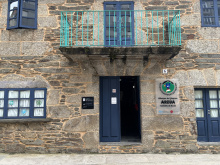
| Albergue de Arzúa 10€ 46 |
|
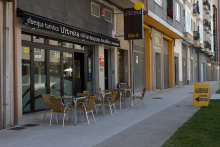
| Albergue Ultreia 14€ 38 Booking.com |
|
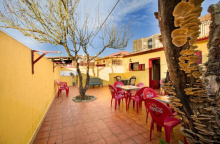
| Albergue Via Lactea 15€ 124 Booking.com |
|
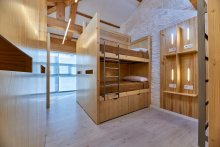
| Albergue San Francisco 16€ 26 Booking.com |
|
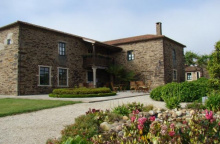
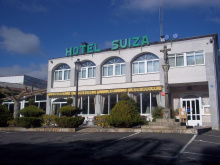

A hamlet on the Francés route between Arzúa and Salceda. No services.
Accommodation in Prégontoño.
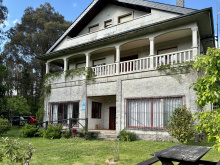
| Albergue Camiño das Ocas 14€ 30 |
|
A hamlet between Arzúa and Salceda. No services.


A hamlet on the Francés route. No services.
Accommodation in Calle - O Outeiro.
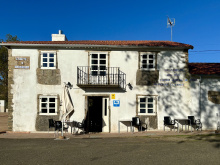
| Albergue A Ponte de Ferreiros 15€ 30 |
|
| Casa Rural do Horreo Booking.com |
|


A pair of bars and a restaurant (La Esquipa) — packed with pilgrims every day but Monday when it's closed. The camino rejoins the road here and crosses it several times between Salceda and Santiago. The speed of traffic, blind curves, and density of pilgrims make this the most dangerous stretch on the Francés. Cross carefully.
The camino rejoins the road in Salceda, and while it does not walk on the road it does remain quite close. In fact, the camino crosses the road several times between here and Santiago. The speed of traffic, the curves in the road, and the abundance of pilgrims makes this the most dangerous stretch along the camino. Cross carefully and quickly and always under the road when possible.
The camino leaves town to the right of a wedge shaped park next to La Esquipa, not along the road.
Accommodation in Salceda.
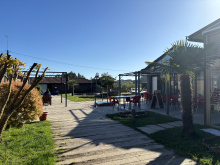
| Albergue Turistico de Salceda 17€ 8 Booking.com |
|

A hamlet where the via Brea variant joins the Francés route. No services.


Several roadside bars serving truckers and pilgrims alike. Dangerous intersection at the road crossing — the crosswalk is unmarked and arrows on the far side are often hidden by parked cars.
CAUTION crossing the road, dangerous intersection.
The camino crosses the main road at the highest point in the road, there is no marked crosswalk and the arrows on the other side of the road are often obscured by parked cars. You may see pilgrims continuing along the road but are advised against following them as the camino returns to the trail when you turn off the road.Half way down the hill it splits and arrows indicate that you should either turn left to go under the road or continue straight. Unless you have reason to visit Santa Irene you can keep on straight and avoid the hassle of crossing back over the road. If you continue straight you will arrive at the important part of Santa Irene (the part with the bar).
Accommodation in Empalme.
| Albergue Andaina 14€ 14 |

A hamlet with a bar. The camino passes through on forest trails between Empalme and O Pedrouzo.
Accommodation in Santa Irene.
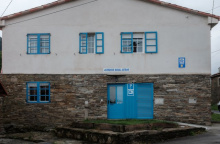
| Albergue Rural Astrar 12-14€ 20 |
|

Where the camino reaches O Pedrouzo, a barrage of arrows and hostel advertisements point in every direction. If you have a reservation, use the map board. Otherwise turn left up the road. If not staying, cross and continue along the camino.
Where the camino returns to the road at the start of O Pedrouzo you will find an abundance of arrows and a large map which is nearly worthless. Arrows and dozens of signs advertising various hostels and hotels point in every direction. If you have a reservation, review the map to find the best path, otherwise turn left up the road. If you are not staying the night in O Pedrouzo, cross the road here and continue along the camino.
O Pedrouzo is where most pilgrims spend their penultimate night. It's a modernized town with abundant beds but no charm, no monuments, and no outrageous legends. During peak season it feels overrun. The camino proper runs through forest to the north — if you stay the night, find the Calle de Condello, head uphill, and pick up the trail.
Avoid the temptation of following the main road out of Pedrouzo. There are very few arrows to get you back to the camino and following along the road puts you in very real danger and takes you away from a lovely forest walk. See note below to get back to the camino.
If you spent the night in O Pedrouzo, it is important to find your way back to the camino proper which runs through the forest to the north. To get to it, find the intersection of the main road and Calle de Condello (where the Casa do Concello is located). Continue uphill (north from here) and in a few hundred meters the camino presents itself. Turn left and continue through the forest to Amenal.The camino between here and Santiago is a mixture of rural and urban settings, some forests and some sprawl. The up and downs that you have been experiencing continue: the elevation gain/loss is +308/-339m, a not insignificant amount.
Accommodation in O Pedrouzo.
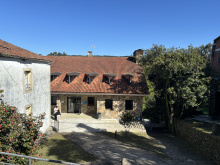
| Albergue de Arca do Pino 10€ 120 |
|
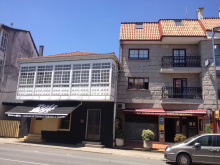
| Albergue Porta de Santiago 12€ 54 |
|
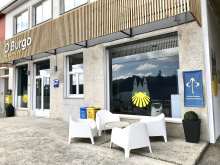
| Albergue O Burgo 16€ 14 Booking.com |
|
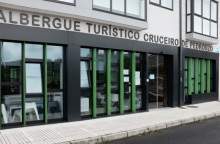
| Albergue Cruceiro de Pedrouzo 12-14€ 94 |
|
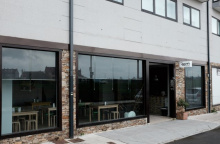
| Albergue REM 13€ 40 Booking.com |
|
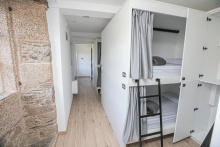
| Albergue Mirador de Pedrouzo 15-17€ 62 Booking.com |
|

A hamlet in the forest between O Pedrouzo and Amenal. No services.
Two bars, one on either side of a dangerous crossing. The camino passes UNDER the N-547 — do not cross over the road. A steep climb follows, then a comfortable trail through eucalyptus forest alongside the Santiago airport runway.
The camino crosses the very busy N-547 by passing underneath it. Do not cross over the road.
Leaving the bar behind you climb steeply uphill a short distance. The path soon levels out on a comfortable trail surrounded by eucalyptus trees. The Santiago Airport is very near, and the camino follows a path around the runway.

The church is dedicated to San Paio (San Pelayo), the 14-year-old saint kidnapped by invading Muslim troops, taken to Seville, and martyred — his body cast into the Río Guadalquivir. All three routes from the Norte converge near here.
The written history of San Paio has been lost to the ages, but the church here is dedicated to San Paio (or Payo), the 14 year old saint who was kidnapped by the invading Muslim troops, taken to Sevilla, and ultimately martyred to pieces and tossed into the río Guadalquivir.

The name Lavacolla has one of the most debated etymologies on the camino, ranging from the prosaic ('field at the bottom of the hill') to the anatomically specific ('wash your scrotum'). What's widely accepted is that medieval pilgrims bathed in this river before entering Santiago.
The last hill awaits. Tradition holds that the first of your group to arrive at Monte del Gozo earns the title of King. The prize for this honor is entirely notional.
The name Lavacolla has one of the most debated origins of all the camino towns. They range from the bland “field at the bottom of the hill” to the more profane “scrub your scrotum.” What is more widely accepted is that pilgrims bathed in this river before entering the Cathedral.
If you walked down the stairs to visit either of the bars at the bottom, turn and walk up the steps towards the Iglesia de Benaval. The camino continues around to the right-hand side and down to cross the road. At the road, cross at the crosswalk and continue along the road and over the famous river (see inset below).The last hill is ahead, and if you are a stickler for doing things according to tradition you should start running now. It is said that the first of your group to arrive in Monte de Gozo is entitled to be called King. Be advised that there is no prize.
Accommodation in Lavacolla.
| Albergue A Fábrica 23€ 34 Booking.com |
|
A hamlet on the final approach to Santiago. No services.
A hamlet before Monte del Gozo. No services.
Monte de Gozo — Mount Joy — was the first place pilgrims could glimpse the Cathedral spires. A new stand of trees now blocks the view. The oversized monument commemorates Pope John Paul II's 1993 pilgrimage. The modest Capilla de San Marcos provides the last stamp, and a kiosk sells cold drinks.
Halfway across the highway bridge beyond Monte del Gozo, you enter the city of Santiago de Compostela.
You do not need to enter the complex but for the sake of curiosity, carrying on down the road will take you where you are heading.Pass the outdoor gallery of a local (and gifted) sculptor of stone and cross the bridge over the highway. It is midway over this bridge that you enter the city of Santiago de Compostela but to keep pilgrims from crossing the road half way across the bridge, the sign indicating such has been moved further into the city.


The outermost barrio of Santiago was once the limit for pilgrims affected with leprosy — they could come no closer. The Iglesia de San Lázaro marks the boundary.
The walk through the urbanized zone delivers you to the Porta do Camiño, through the stone-paved lanes, past the Plaza Cervantes, under the Bishop's residence, and into the Plaza de Obradoiro. Welcome to Santiago de Compostela.
This outermost barrio of Santiago was once the closest point that pilgrims affected with leprosy were permitted to go.
The walk into Santiago is through the urbanized zone that has grown up around the old town. After passing over the highway bridge the first part of Santiago you walk through is the Barrio San Lazaro; the church here is said to be the limit for pilgrims with leprosy. There is a fairly large intersection to cross where the arrows disappear and are replaced by blue and yellow signs on posts.At last, you will enter the old town, through the Porta do Camiño, winding gently through the stone paved lanes, through the Plaza Cervantes, under the Bishops residence, and into the Plaza de Obradoiro. Congratulations, and welcome to Santiago de Compostela!
Accommodation in Barrio San Lázaro.
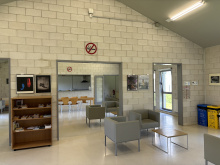
| Residencia de Peregrinos San Lázaro 10€ 80 |
|
