
Penafuente sits at the top of a long, gentle climb along the AS-28. The view behind you stretches back across the mountains you've crossed. From here the camino crosses through town to the right and follows a track above the road.
The camino crosses through town to the right and follows a track above the road, and eventually intersects it. Cross the road and continue UP the track, NOT down towards Bustelo.

Bar on the road at the alto. Higher prices for tourists have been reported, so confirm before ordering. Between here and A Fonsagrada the camino follows near or directly on the main road, passing through Cabreira and Fonfria.
The camino passes the bar at the alto and keeps off of the road for a short distance. Between here and Fonsagrada it will follow adjacent to, or directly on, the main road. You will pass through Cabreira halfway to Fonfría.


Fonfria -- Cold Fountain -- takes its name from the spring that feeds the village fountain and that attracted the construction of a pilgrim hospital here in the late Middle Ages. The water is still cold and still good. From time to time one of the villagers opens her kitchen to invite passing pilgrims in for a coffee -- the kind of spontaneous hospitality that defines the Primitivo.
Standing directly between Fonfría and Barbeitos is a small hill. The road goes around it to the north and the camino goes around it to the south. The two meet in Barbeitos.
The Meson Catro Ventos (Four Winds) sits at a road interchange where the camino crosses over and back. The name fits -- you're high enough and exposed enough to feel wind from every direction.
The camino crosses over the road here only to cross back when it gets to Silvela.
Old arrows from Paradanova may tempt you to follow the road, you are better off following the trail to enter Fonsagrada from the North on a quieter road.
Just beyond Silvela, on the forest track that connects it with Paradanova, you will pass an ermita and a restored capilla dedicated to Santa Bárbara. The camino passes straight through Paradanova 155.9. Immediately at the far end of town it crosses the road and climbs up to Fonsagrada along a back road. See note below about possible conflicting arrows.
Be advised that there have been a growing number of false arrows in Paradanova. Some of them are the official looking blue and yellow plastic (most are painted arrows) signs.
These arrows are intended to detour you from Fonsagrada and towards A Proba de Burón and should be ignored.
The real camino into Fonsagrada follows South of the road (keep road on your right and dont cross it).
If you find that you have mistakenly followed the wrong arrows you will have another opportunity to get to Fonsagrada by turning left at the next large intersection.
A Fonsagrada is the first town of serious size since crossing into Galicia. It won't make any postcards, but it has everything you need, including a real selection of restaurants. This is Galicia -- try the pulpo a feira (octopus with paprika, olive oil, and salt on heavy bread), washed down with a local white wine. The addition of several albergues here in recent years has led to the closure of the old albergue in Padron, the next town.
A Fonsagrada is one of the largest municipios in Spain by area, a reflection of just how sparsely populated this corner of Galicia remains. The terrain ahead between Padron and O Cadavo is arguably the toughest stretch on the entire Primitivo -- locals call it the rompe piernas, the leg-wrecker. Allow extra time, especially after rain when the forest tracks turn to thick mud.
The camino between Padrón and O Cádavo is arguably the most difficult of the route, and possibly the reason for the nickname the leg wrecker. Allow for extra time, especially after a rain since many of the sections become thick with mud.
The sacred fountain (fons sacrata) that gives the town its name is located behind the Iglesia de Santa Maria de Fonsagrada, on the aptly named Rua do Fonte. The spring and its supposedly curative waters are wrapped in layers of local lore and medieval miracle stories. The fountain predates the town -- pilgrims likely stopped here to drink long before anyone thought to build around it.
The camino exits Fonsagrada along the main road, and shortly after follows a secondary road parallel to it, into Padrón. Beyond Padrón it follows through forested paths off of the road.

Not to be confused with the much more famous Padron near Santiago. This is a small village just beyond Fonsagrada, and the former albergue here has closed. The camino between Padron and O Cadavo earns its reputation as the rompe piernas -- expect steep ascents, deep mud in wet weather, and stretches where the path is more stream than trail. It's genuine mountain walking through deep forest, and on a clear day it's magnificent.


The ruins of the Hospital de Montouto sit at the alto, though as history has shown they may not stay in one place for long -- this refuge for pilgrims has been relocated more than once since it was first built in 1357, shifting position as the camino route itself changed over the centuries. A small chapel survives.
The Hospital de Montouto was established in 1357 to shelter pilgrims crossing this exposed mountain pass. Like the hospitals on the Hospitales route, it was placed at altitude precisely because the terrain was lethal in bad weather. The fact that it was rebuilt and relocated multiple times speaks to both the harshness of the environment and the persistence of the pilgrimage tradition.
On the 25th of July the chapel here is the destination for a romeria from Fonsagrada in honor of Santiago.
From this alto it is a 300m descent to Paradavella in less than 4km. The path is entirely off of the road along a forest track.
From Paradavella the camino follows a trail to the right of the road and crosses it to descend into the village of Calzada (meaning road). The next village, also without services, is Degolada. The camino keeps to the south of the road along the path and eventually climbs up to rejoin it as it enters A Lastra.

At the far end of A Lastra keep to the left, along the oncoming exit road, and just before it returns to the main road turn left uphill towards the houses. The climb continues steeply uphill for a gain of about 150m and the last part rejoins the road as it enters Fontaneira.
Between Fontaneira and O Cadavo lies a small plateau known as the Campo da Matanza. According to legend, it was here that Alfonso II -- the same king who established the Primitivo as a pilgrimage route -- and his forces defeated a Muslim army in 813. The historical accuracy is debatable, but the name (Field of Slaughter) has stuck for over a thousand years.
At the far end of Fontaneira leave the LU-530 for a small road uphill (direction Pandelo). You will pass the cemetery and then return to the main road to follow it for close to 1km. The camino then leaves the road in favor of a path on the right. As you descend to O Cádavo you will cross the Campo da Matanza.
O Cadavo remains a largely agricultural town where the industry is cows -- both dairy and beef -- and you're bound to see more than one tanker truck on its rounds. The town sits at a slightly lower altitude than the surrounding terrain, which makes a substantial difference in snowfall during winter months. The views from the approach are wide and open, a taste of the rolling Galician landscape that replaces the sharp mountain terrain you've been crossing.
The town itself is unremarkable but functional, with enough services to resupply and enough bars to celebrate surviving the rompe piernas.
The camino between here and Castroverde manages to avoid the steep LU-530 entirely. From O Cádavo it continues uphill along a farm lane to the town of Pradeda where you can look back for a nice view of O Cádavo. Beyond Pradeda the climb continues up to the Alto de Vacariza.

The camino beyond the alto splits and there is now a new type of marker to contend with. In 2016 the Galician government installed new stones to mark the camino. When they were installed the routes were re-examined by planners and several changes and additions were made. In this case, the old camino route was re-named the complementaria route, and a second route was added as the official route. This business of creating complementaria routes has led to much confusion because in some localities (Arzúa is the nearest example) it was applied to a route (for historical reasons) which for decades has been the only option; causing many pilgrims to waste time looking for an official route which does not exist. In this case the old camino has been renamed the complementaria. This guidebook however continues to treat it as the original and still preferred option and the distances indicated are along it. It is 5.5km from the split to Castroverde along the complementaria option, and 4.7 along the newer option.
The Gothic church in Vilabade is a national monument and is known locally -- with only slight exaggeration -- as the Cathedral of Castroverde. It's genuinely impressive for a village this size, with a rose window and carved portal that reward a close look. In summer a small food truck may be parked at the edge of town.
The camino follows the road from here all the way to Castroverde, and the first building on your right when you get back to the LU-530 is the municipal albergue.
Castroverde marks the end of the serious descent and the beginning of a different landscape. The terrain ahead is not flat, but compared to the mountains you've crossed it could pass for gently rolling. The farmland that stretches from here to Lugo -- and indeed for the next 80 kilometers, with the exception of Lugo itself -- is some of the most productive in Galicia.
The town's most notable landmark is the Torre de Homenaje, a 20-meter tower that's the only part left standing of the 14th-century castle that gives the town its name. The local church is dedicated to Santiago -- appropriate for the route you're on. A stamp is available at the town hall opposite the church.
Stock up on food here. Apart from vending machines, there's nowhere to eat between Castroverde and Lugo, a distance of 21 kilometers.
Apart from vending machines there are no places to get food between here and Lugo, a distance of 21km. Pack a lunch.
The camino passes through town to the south (left) of the LU-530 and after passing the town hall it joins a trail through a chestnut forest. When it returns to the LU-530 it crosses straight over it (caution!) and turns left to go through a tunnel. It passes through San Miguel do Camiño and an unnamed hamlet before entering Souto de Torres.

A small village marked by a chapel and a cruzeiro at the entrance. The country lane from here leads through quiet farmland all the way to Vilar de Cas.
Turn right at the entrance to town and follow this country lane all the way to Vilar de Cas, passing through one more unnamed hamlet along the way.

At the end of town there are markers for another complementaria route, this time for a detour to the Iglesia de Soutomerille (see below). This worthwhile alternative adds 700m to the journey, through an evergreen forest.
Accommodation in Vilar de Cas.
| Albergue A Pociña de Muñiz 20€ 16 |

|
The first 1.8km from Gondar are along the paved road. The camino will eventually leave it along a trail to the right. It nears the village of Bascuas 110.2 and then returns to the LU-530. Along this busy road to Lugo you will pass a sign announcing the entrance to Carballido, though you won’t ever see the town which is through the forest to your left. Instead, the camino turns to the right 400m after this sign to resume walking along a country road to the hamlet of As Casas da Viña.

Bascuas lies just north of the camino. Black and yellow arrows point right to keep you on the path, which no longer passes through the village itself. The camino turns left to parallel the main road into Lugo.
If you're a dutiful follower of arrows, you'll enter and exit Carballido without ever seeing more than the road signs. The village is through the trees to the south -- a small cluster centered on one large estate and a chicken processing plant. The camino keeps to the road, mindful of traffic, before turning right onto a safer side road.

As Casas da Vina is no larger than any of the hamlets you've passed through, but it's the last one before the suburbs of Lugo. From here the approach to the city passes through some unappealing surroundings -- divided highways and overpasses that the camino must navigate. The walled city that eventually appears above you makes the suburban trudge worthwhile.
As the route approaches Lugo it passes through some rather unappealing surroundings. Lugo is the capital of the region and is surrounded by divided highways which the camino must navigate safely. When it arrives at the highway it makes a right turn and continues to a small overpass which is much safer for pedestrians. You are on a mostly disused road until the next sign of habitation appears.
The barrio known as A Chanca sits along the río Rato in the shadow of a stone railway bridge. From here it is an uphill climb up to Lugo. After passing under the railway cross the road to your right at the first marked pedestrian crossing. Take the stairs on your left to the Rúa de Fontiñas. Turn left here, following the arrows, but cross to your right at the first pedestrian crossing. This road will take you straight up to the old walled city and one of the city gates. The municipal albergue is just inside the wall and to the right down a side street.

Lugo's Roman walls are the single most extraordinary thing you'll encounter on the Primitivo. They are the only complete Roman walls surviving anywhere in the world -- over 2 kilometers of continuous circuit, up to 15 meters tall in places, with 71 towers and 10 gates. If your feet can stand another walk, climb one of the staircases (there's one directly in front of the Cathedral) and follow the pedestrian path that runs along the top. The circuit takes about 30 minutes and gives you an elevated view of both the old town and the modern city beyond.
Inside the walls, the Cathedral of Santa Maria was begun in 1129 and took 150 years to build, mixing Romanesque and Gothic elements. The Chapel of the Virgen de los Ojos Grandes (Our Lady of the Big Eyes) is the emotional heart of the building -- the wide-eyed Romanesque virgin in her ornate Baroque chapel is one of the most beloved religious images in Galicia. The Baroque cloister, added centuries later, provides a quieter counterpoint.
The Praza do Campo and the adjacent streets form the commercial heart of the old town, full of bars, restaurants, and small shops. This being Galicia, pulpo dominates the menus -- Lugo takes its octopus seriously. The Termas Romanas, discovered during construction work, are a reminder that the Romans valued this spot for more than its defensive position.
The municipal albergue is just inside the wall, to the right of the gate where the camino enters.
There is a stretch of 10km west of Lugo without any services for pilgrims. Stock up before you leave.
The Romans established Lucus Augusti here in 13 BC, and the city's name may derive from Lugos (a Celtic god of light) or from the Latin lucus (sacred grove) -- scholars have argued both sides for centuries without resolution. The walls were built in the 3rd century AD, originally with 85 towers, and they have survived remarkably intact because the city never stopped using them. Medieval, Renaissance, and modern construction simply built up against and around them.
The walled city occupied a strategic position above three rivers -- the Mino, Rato, and Chanca -- and its prosperity lasted centuries before the city was largely abandoned in the 8th century. The slow revival that followed was fueled by the pilgrimage to Santiago, and by the Middle Ages, Lugo had regained its importance. Agriculture drove continued growth, and the city now extends far beyond anything the Romans envisioned.
During the last weeks of June, Lugo celebrates Arde Lucus (Burn Lugo). Residents dress in Roman costumes and the city relives its origins with processions, markets, and performances. The festival draws close to half a million people, so book accommodation well in advance if you're passing through. The Festa de San Froilan in October is the other major celebration -- Galicia's largest autumn festival, centered on food, music, and the saint who was bishop of Lugo in the 9th century.
The camino leaves the walled city at the gate opposite the Cathedral and proceeds downhill along the Rúa de Santiago. Halfway down the hill it bears right onto the Rúa Calzada da Ponte. It crosses a divided boulevard and descends all the way down to the río Miño.
The Ponte Romano carries you over the river and once on the other side, it turns right to follow along the river bank. After passing the Iglesia de San Lázaro it turns up to the left and follows the road to pass under the N-540. There is one more large intersection ahead and it is a simple matter of crossing straight over it. From here you will follow along the paved road, the LU-P-2901, all the way to San Román de Retorta.
Landmarks along the way include the Santuario de Santo Matías and the hamlets of Seoane de San Xoán do Alto 92.2 and Carrigueiros 90.7.
Accommodation in Lugo.
| Albergue de Lugo 10€ 42 |
|


A hamlet on the road between Lugo and San Romao da Retorta. Beyond here the camino leaves the road for a trail that passes through Bacurin -- in heavy rain, the road is the safer option as the trail becomes waterlogged.
Beyond As Searas, the camino leaves the road for a trail that passes through the village of Bacurin 86.3. During periods of heavy rain, it is possible to stay on the road. From Bacurin the camino returns to the road and passes through the hamlets of O Paso, Hospital, and San Pedro de Abaixo. The next hamlet, Taboeiro 81.9, may have a bar which is open. If not there is a small detour of 100m to the bar in nearby Crecente (closed Mondays).
The bar in San Roman opens daily from 11am. The staff are helpful and keep tabs on bed availability in the two albergues further along the trail.
Pay attention here: San Roman sits at an intersection of two country roads, and old arrows may still exist pointing toward Palas de Rei on the Camino Frances rather than toward Melide. The correct route to Melide -- which is where the Primitivo officially joins the Frances -- heads southwest. Follow the newer markers.
Things tend to get a bit tricky here if you are not fully aware. San Román sits at the intersection of two country roads, and from here the camino goes off in two different directions, or at least it did until last year. This means that old arrows may still exist which would take you to Palas de Rei on the Camino Francés rather than to Melide.
From the bar in San Román head west (turn right when leaving the bar). When you emerge on the road some 70m later, cross the road and take the path opposite you. The albergues are a short distance onward.

The camino follows the country lane out of Castrelo. It passes the village of Burgo de Negral 77.6 (with picnic area) and Pacio 75.6. The next town is Ferreira and one of the albergues there (Cruz Ferreira) is actually located along the road 1km before town.
Accommodation in Castrelo.
| Albergue de peregrinos de San Román da Retorta 10€ 12 |

| Albergue O Cándido 14*€ 21 |
A tiny hamlet with no services. Keep moving.
Ferreira is one of the slightly larger hamlets between San Roman and Melide, with a bar and a chapel. The walking through this section is quintessentially Galician -- eucalyptus forests alternating with small farms, stone walls lining the paths, and the occasional horreo standing in a field.
A small Galician hamlet with a chapel. The camino passes through on its way to Merlan.
Shortly beyond the church in San Xurxo, near the stone marked 68.3, the camino splits. It is possible, but not at all recommended, to follow the LU-P-2901 south to Palas del Rei. To avoid doing so, look for the arrows which have you leave the road in favor of a trail on your right. The trail doesn’t last long and soon you are on a different paved road and entering the hamlet of Merlán.

Merlan has a bar and the sense that you're getting closer to civilization -- the hamlets are slightly larger and the roads slightly wider. The walking ahead through As Seixas and beyond is pleasant, rolling Galician countryside.
Shortly after passing through Merlán turn off the road to your left. This narrow lane will deliver you to As Seixas.
As Seixas has a couple of bars and marks the last significant stop before the camino descends through increasingly hilly terrain toward Melide. The name recalls the granite bedrock (seixo = pebble/stone) that underlies much of inland Galicia.
Beyond As Seixas the camino leaves the road and follows a trail to Casacamiños.
From town, the camino turns north to O Hospital das Siexas, the last hamlet in Lugo. Shortly beyond, on the ridge of the Sierra del Careón, it enters the region of La Coruña.
The Sierra del Careon is a modest mountain range that the Primitivo crosses on its way to Melide. The terrain here is open heathland -- a final reminder of the mountain character that has defined this route since Oviedo.
The camino goes up and over the ridge that divides Lugo from La Coruña. A short distance beyond it leaves the road for a trail and descends through the hamlets of Vilouriz and Vilamor before entering Irago de Arriba.
Irago de Arriba is the last village before Melide. There's a bar and the sense of anticipation that comes with knowing you're about to join the Camino Frances -- and with it, a dramatic increase in pilgrim traffic. If you've been walking the Primitivo in relative solitude, the change will be noticeable.
Between Irago and Melide there are a number of small villages and urban sprawl. The first bars appear on the road into Melide.

Melide is where the Primitivo joins the Camino Frances for the final 55 kilometers to Santiago. After days of mountain solitude, the sudden crowd of pilgrims can be disorienting -- or energizing, depending on your temperament.
The town itself has been welcoming pilgrims for centuries. The Iglesia de San Pedro dates to the 14th century and contains notable medieval frescoes, while the Iglesia de Sancti Spiritus holds a 14th-century stone crucifix considered one of the oldest in Galicia. The small Museo da Terra de Melide occupies the former Hospital del Sancti Spiritus and is worth a visit if it's open.
But Melide's real claim to fame is its pulpo. The town has been the unofficial capital of pulpo a feira since long before the camino became fashionable, and the pulperias here are the real thing -- octopus cooked in copper pots, served on wooden plates with paprika, olive oil, coarse salt, and heavy bread. A Garnacha and Ezequiel are two of the most established. Arrive at lunch and eat as the Galicians do -- standing at the bar, with a glass of Ribeiro wine and your sleeves rolled up.
From Melide the route to Santiago is shared with the Frances. The terrain is gentler, the services more frequent, and the company considerably more abundant. You've earned the easy finish.
Melide's strategic position at the junction of two major camino routes made it an important medieval town. Several pilgrim hospitals operated here, and the 14th-century stone cross near the Iglesia de San Roque is one of the oldest surviving cruceiros in Galicia. The frescoes inside San Pedro -- depicting the Assumption and other biblical scenes -- are rare survivors from the 14th century and worth seeing before the crowds make quiet contemplation impossible.
The traffic through Melide can be dangerous, particularly on market days when booths line the crowded streets and the arrows through town become difficult to spot. Arrows direct you towards a small side street through the old part of town that parallels the main road. There are many other yellow arrows that direct you towards the many albergues in town, they are often attached to adverts or are painted alongside a simple ‘A’. These can be ignored.
Accommodation in Melide auf dem Camino Primitivo.
| Albergue Pereiro 13€ 40 Booking.com |

|
| Albergue O Cruceiro 13€ 88 |

|
| Albergue Melide 14€ 57 Booking.com |

|
| Albergue Pension San Antón 15€ 28 Booking.com |

|
The Bar de los Alemanes (German Bar), the first building on your left entering from the east, is the best bar in the village. Further down the hill, the camino crosses the main road (caution) where two albergues and a few bars are located.
The Iglesia de Santiago de Boente has an image of Santiago — one of the few remaining Romanesque images of the saint on the Camino, though much restored. You can get a sello here.
Past the church, the camino turns right and descends. The hills ahead involve steep ups and downs — take it easy on tired legs.
Castañeda is historically significant as the site of the medieval lime kilns where pilgrims from Triacastela delivered the limestone they'd carried across Galicia. The lime was burned here and transported to Santiago for use in building the cathedral. It was a form of pilgrim labor — a practical contribution to the goal of the journey.
The lime kilns connected the quarries of Triacastela (over 100 km to the east) with the cathedral construction in Santiago. Pilgrims who carried stones were performing an act of devotion while providing essential building material.
It is uphill once more, followed by a steady descent into the valley below, steep at points.

A beautiful riverside spot with a bar, a patio, and a medieval bridge. The river water is cold and perfect for soaking tired feet. The old pilgrim hospital has been converted into an albergue — one of the more atmospheric on this section.
This is one of the last truly peaceful stops before the approach to Santiago brings increasing traffic and noise.
The climb from Ribadiso to Arzúa is steady. By the time you reach the road, it levels off and the remaining distance into town is flat.

An albergue operates in the upper part of Ribadiso, at the top of the climb before Arzúa. Useful if the lower riverside spot is full.
Accommodation in Ribadiso da Carretera.
| Albergue Milpes 15€ 24 Booking.com |

|
| Miraiso 15€ 10 |

|
Arzúa is the cheese capital of Galicia. The Queixo de Arzúa-Ulloa has its own Denominación de Orixe, and the tetilla cheese — named for its distinctive breast shape — is everywhere. The tetilla's form was supposedly created by cheesemakers in protest: when the bishop ordered the removal of nude figures from the Pórtico de la Gloria in Santiago, the cheesemakers responded by making their product unmistakably anatomical. The story may be apocryphal, but the cheese is real and excellent.
This is where the Camino del Norte joins the Francés, and the trail gets noticeably busier from here to Santiago. The town is functional and well-serviced: multiple albergues and hotels, bars and restaurants, supermarkets. If everything is full, the polideportivo (sports hall) is sometimes opened for overflow.
The camino leaves Arzúa on a footpath, not the road. From the main square, walk past the church (back to the road) and turn right.
Arzúa has been a waypoint on the pilgrim road since the earliest documented routes. Its position at the junction of the Francés and Norte routes made it a natural gathering point.
The Festival of Cheese in March is a three-day celebration of the local product — 40 years running. Corpus Christi and Nuestra Señora del Carmen (July 16) are also celebrated.
The camino leaves Arzúa along a footpath, NOT the road. If you arrived at the main square, walk past the church (with your back to the road) and turn right onto the side street. The terrain is pleasant, a blend of trails and paved roads through small towns and lots of forests. There are a few steep sections but none of any considerable length.
Accommodation in Arzúa.
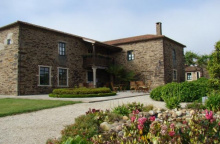

A hamlet on the Francés route between Arzúa and Salceda. No services.
Accommodation in Pregontoño.
| Albergue Camiño das Ocas 14€ 30 |
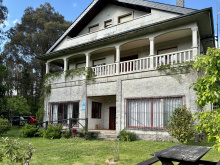
|

A hamlet on the Francés route. No services.


A pair of bars and a restaurant (La Esquipa) — packed with pilgrims every day but Monday when it's closed. The camino rejoins the road here and crosses it several times between Salceda and Santiago. The speed of traffic, blind curves, and density of pilgrims make this the most dangerous stretch on the Francés. Cross carefully.
The camino rejoins the road in Salceda, and while it does not walk on the road it does remain quite close. In fact, the camino crosses the road several times between here and Santiago. The speed of traffic, the curves in the road, and the abundance of pilgrims makes this the most dangerous stretch along the camino. Cross carefully and quickly and always under the road when possible.
The camino leaves town to the right of a wedge shaped park next to La Esquipa, not along the road.
Accommodation in Salceda.
| Albergue Turistico de Salceda 17€ 8 Booking.com |
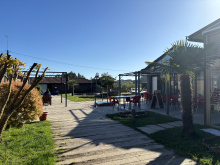
|

A hamlet where the via Brea variant joins the Francés route. No services.

Several roadside bars serving truckers and pilgrims alike. Dangerous intersection at the road crossing — the crosswalk is unmarked and arrows on the far side are often hidden by parked cars.
CAUTION crossing the road, dangerous intersection.
The camino crosses the main road at the highest point in the road, there is no marked crosswalk and the arrows on the other side of the road are often obscured by parked cars. You may see pilgrims continuing along the road but are advised against following them as the camino returns to the trail when you turn off the road.Half way down the hill it splits and arrows indicate that you should either turn left to go under the road or continue straight. Unless you have reason to visit Santa Irene you can keep on straight and avoid the hassle of crossing back over the road. If you continue straight you will arrive at the important part of Santa Irene (the part with the bar).


A hamlet with a bar. The camino passes through on forest trails between Empalme and O Pedrouzo.
Accommodation in Santa Irene.
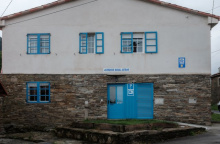
| Albergue Rural Astrar 12-14€ 20 |
|

Where the camino reaches O Pedrouzo, a barrage of arrows and hostel advertisements point in every direction. If you have a reservation, use the map board. Otherwise turn left up the road. If not staying, cross and continue along the camino.
Where the camino returns to the road at the start of O Pedrouzo you will find an abundance of arrows and a large map which is nearly worthless. Arrows and dozens of signs advertising various hostels and hotels point in every direction. If you have a reservation, review the map to find the best path, otherwise turn left up the road. If you are not staying the night in O Pedrouzo, cross the road here and continue along the camino.
O Pedrouzo is where most pilgrims spend their penultimate night. It's a modernized town with abundant beds but no charm, no monuments, and no outrageous legends. During peak season it feels overrun. The camino proper runs through forest to the north — if you stay the night, find the Calle de Condello, head uphill, and pick up the trail.
Avoid the temptation of following the main road out of Pedrouzo. There are very few arrows to get you back to the camino and following along the road puts you in very real danger and takes you away from a lovely forest walk. See note below to get back to the camino.
If you spent the night in O Pedrouzo, it is important to find your way back to the camino proper which runs through the forest to the north. To get to it, find the intersection of the main road and Calle de Condello (where the Casa do Concello is located). Continue uphill (north from here) and in a few hundred meters the camino presents itself. Turn left and continue through the forest to Amenal.The camino between here and Santiago is a mixture of rural and urban settings, some forests and some sprawl. The up and downs that you have been experiencing continue: the elevation gain/loss is +308/-339m, a not insignificant amount.
Accommodation in O Pedrouzo.
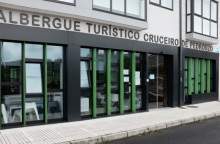
| Albergue Cruceiro de Pedrouzo 12-14€ 94 |
|
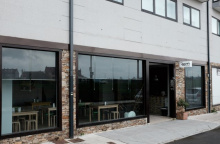
| Albergue REM 13€ 40 Booking.com |
|

A hamlet in the forest between O Pedrouzo and Amenal. No services.
Two bars, one on either side of a dangerous crossing. The camino passes UNDER the N-547 — do not cross over the road. A steep climb follows, then a comfortable trail through eucalyptus forest alongside the Santiago airport runway.
The camino crosses the very busy N-547 by passing underneath it. Do not cross over the road.
Leaving the bar behind you climb steeply uphill a short distance. The path soon levels out on a comfortable trail surrounded by eucalyptus trees. The Santiago Airport is very near, and the camino follows a path around the runway.

A hamlet near the airport perimeter. No services.
The church is dedicated to San Paio (San Pelayo), the 14-year-old saint kidnapped by invading Muslim troops, taken to Seville, and martyred — his body cast into the Río Guadalquivir. All three routes from the Norte converge near here.
The written history of San Paio has been lost to the ages, but the church here is dedicated to San Paio (or Payo), the 14 year old saint who was kidnapped by the invading Muslim troops, taken to Sevilla, and ultimately martyred to pieces and tossed into the río Guadalquivir.

The name Lavacolla has one of the most debated etymologies on the camino, ranging from the prosaic ('field at the bottom of the hill') to the anatomically specific ('wash your scrotum'). What's widely accepted is that medieval pilgrims bathed in this river before entering Santiago.
The last hill awaits. Tradition holds that the first of your group to arrive at Monte del Gozo earns the title of King. The prize for this honor is entirely notional.
The name Lavacolla has one of the most debated origins of all the camino towns. They range from the bland “field at the bottom of the hill” to the more profane “scrub your scrotum.” What is more widely accepted is that pilgrims bathed in this river before entering the Cathedral.
If you walked down the stairs to visit either of the bars at the bottom, turn and walk up the steps towards the Iglesia de Benaval. The camino continues around to the right-hand side and down to cross the road. At the road, cross at the crosswalk and continue along the road and over the famous river (see inset below).The last hill is ahead, and if you are a stickler for doing things according to tradition you should start running now. It is said that the first of your group to arrive in Monte de Gozo is entitled to be called King. Be advised that there is no prize.
Accommodation in Lavacolla.
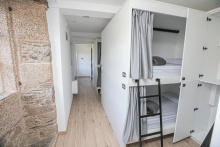
| Albergue A Fábrica 23€ 34 Booking.com |
|
A hamlet on the final approach to Santiago. No services.
A hamlet before Monte del Gozo. No services.