
Granja de Moreruela is where the road forks and where you make a decision that will shape the rest of your Camino. You can continue north along the Via de la Plata to Astorga (93.8 km) and pick up the Camino Frances from there, or you can turn west onto the Camino Sanabres toward Santiago via Ourense (366 km). Most pilgrims on the Via de la Plata choose the Sanabres option, and with good reason -- it's a direct line to Santiago through some of the least populated, most quietly beautiful country in Spain.
Before you leave Granja, walk out to the ruins of the Monasterio de Santa Maria de Moreruela, about 2 km west of the village. What's left -- the apse, with its ambulatory and ring of seven chapels -- is enough to give you a sense of the scale this place once commanded. Founded in the 12th century, Moreruela was one of the earliest Cistercian monasteries on the Iberian Peninsula, a daughter house of Clairvaux itself. The church alone was 63 metres long. Most of it is gone now, but the apse still stands tall against the sky, and in the early morning light it's a fine place to start a journey.
The village itself has a small shop, a bar, and an albergue. Services are basic. Stock up on what you need -- the first 18 km to Faramontanos de Tabara have nothing.
The Monasterio de Santa Maria de Moreruela was founded around 1131-1133, making it a strong candidate for the oldest Cistercian foundation in Spain. Under the patronage of Alfonso VII, the monastery became a daughter house of Clairvaux and in turn mothered Nogales Abbey (1164) and Aguiar Abbey in Portugal (1165). The Romanesque church, begun around 1170 and finished in the second quarter of the 13th century, was built in the shape of a Latin cross stretching 63 metres in length. Its ambulatory apse with seven radiating chapels followed the plan of Clairvaux itself. Like so many monastic houses in Spain, Moreruela was emptied by the ecclesiastical confiscations of 1835 and slowly crumbled. What remains of the apse is considered one of the finest examples of Cistercian architecture in the country.
The Camino Sanabres turns left and due west from Granja. It follows farm tracks to reach the Puente Quintos (6.7 km) over the Rio Esla. Once over the bridge, the route splits into two options to reach Faramontanos de Tabara. The right route follows the road and is preferred when rains have been heavy. Follow the road to the first paved left turn to descend and rejoin the left route. The left route turns left at the end of the bridge to follow a more scenic trail along the river.
There are no services for the first 18 km. Carry food and water from Granja.

A small village on the banks of the Rio Esla. The camino passes through on its way north. Limited services -- don't count on finding anything open.

A tiny hamlet between Santovenia and Barcial del Barco. No services. The walking through here is flat agricultural land, typical of the Zamora meseta.
The social center of town is the Bar Borox, which doubles as the albergue's reception. If you need anything -- keys, directions, a cold drink -- this is where to find it.
The Via Verde de la Plata, a converted railway line turned pedestrian path, runs nearby and provides an alternative route into Benavente. The rail line operated until the 1980s and has been repurposed as a flat, paved walking and cycling path. It's the recommended approach to Benavente, delivering you directly to the albergue in a repurposed railway building.
Beyond Barcial de Barco a bit of care is needed to keep to the camino. If you have any doubts, speak with the owners of the bar Borox (adjacent to the albergue), they sometimes provide a map of the way.
The confusion has to do with the recent development of a disused railway line into a pedestrian path known as the Via Verde. This is the recommended way as it delivers you directly to the albergue in Benavente (which itself is in a repurposed rail yard building).
After leaving Barcial de Barco the camino returns to the N-630 and crosses it; at this point you can see (ahead and on the left) the elevated Via Verde. The camino will eventually pass beneath it, and it is here that you can take the stairs up to the walkable level. From there it is a simple matter of following it all the way to the railway yard in Benavente.

Now separated from the camino with the opening of the Via Verde. If you're following the converted railway path, you'll bypass this village entirely.

Benavente is the first real town since Zamora and the place to stock up on everything you need. With around 18,000 inhabitants, it's the largest settlement between Granja de Moreruela and Astorga, and the services reflect that -- supermarkets, pharmacies, banks, and a proper selection of restaurants.
The town sits at the confluence of the Esla and Orbigo rivers, a strategic position that made it a medieval crossroads. The most impressive survivor of that era is the Torre del Caracol, the surviving tower of the castle of the Counts of Benavente. The full castle was destroyed during the Peninsular War by Napoleon's troops in 1809 -- they sacked the town and burned what they couldn't carry. The tower, with its elaborate plateresque windows, now forms part of the Parador, and the views from the terrace over the river valley are worth the walk up.
The Iglesia de Santa Maria del Azogue dates to the 12th century and mixes Romanesque and Gothic elements. The name azogue derives from the Arabic word for market -- the church was built at the commercial heart of medieval Benavente. The south portal retains its Romanesque archivolts and carved capitals. Inside, the Romanesque apse with blind arcading is the highlight.
The Iglesia de San Juan del Mercado, also 12th century, is the other significant church. Its south facade carries remarkably well-preserved Romanesque sculpture, including a tympanum depicting the Adoration of the Magi.
Benavente's strategic position at the river junction made it a prize worth fighting over. The Counts of Benavente, one of the most powerful noble families in Castile, held the town for centuries. Their castle was legendary for its size and grandeur -- the library alone was one of the largest in 16th-century Spain.
Napoleon's forces arrived on January 1, 1809, during the British retreat to La Coruna. Sir John Moore's rearguard fought a brief delaying action here before the French overwhelmed the town. The destruction was comprehensive -- the castle was gutted, and much of the town burned. What you see today at the Parador is what survived.
Fiestas del Toro Enmaromado during Corpus Christi (May-June). A bull is led through the streets on a rope -- one of the oldest bull-running traditions in Spain, documented since the 13th century. The Virgen de la Vega is celebrated on the 8th of September.
Note that it is technically possible to follow the Vía Verde all of the way to Villabrázaro, but that the arrows don’t really give you a good way to find where to depart from it and resume the camino.
From the albergue in Benavente, follow the Vía Verde a short distance until the road that it is parallel to it (on your right) turns away from the path. Here the camino leaves the Vía Verde and follows the road to the right. A short distance on it turns left and follows the road out of town and all the way to Villabrázaro
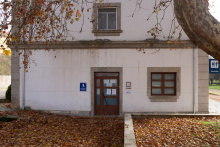
Accommodation in Benavente.
| Albergue de peregrinos de Benavente 5€ 12 |
|

Check with the Bar Real for keys to the albergue. A small village with limited services beyond the bar. The camino follows a paved country lane from here to Maire de Castroponce.
The camino follows a paved country lane to Maire de Castroponce, well marked.


A quiet village on the road between Villabrazaro and Alija del Infantado. No significant services. The terrain from here continues as flat agricultural meseta until the Rio Orbigo crossing.
The way to Álija del Infantado is complicated by only one turn. The camino follows a paved road most of the way and eventually arrives at a larger paved road after crossing the Puente de la Vizana over the Río Órbigo (and into the province of León). Pilgrims who have walked the Camino Francés may recognize the name, this crossing is downstream from the famous bridge at Hospital de Órbigo.
Here the camino arrows indicate a way straight ahead. However other arrows direct you to turn left along the road. If you plan to stay in the albergue, choose the latter option along the road. Both will get you there but the path ahead brings you to town well past the albergue.

Two churches worth your attention, but if you only visit one, make it the Iglesia de San Esteban. The coffered Mudejar ceiling is the reason to stop -- an intricate geometric pattern of interlocking wooden panels, painted and carved in the tradition that Moorish craftsmen brought to Christian Spain. Mudejar work this well preserved is uncommon outside of major cities, and finding it in a village this small is a genuine surprise.
The Iglesia de San Verismo is the other church, less celebrated but with its own quiet appeal.
The castle ruins on the hill above town date to the 12th century. The Infantado in the town's name refers to its status as a royal infante's holding -- land granted to a prince of the crown.
The castle was built in the 12th century and expanded in the 14th and 15th centuries under the Dukes of the Infantado. The Mudejar ceiling in San Esteban dates to the 15th century and represents the artistic tradition of Moorish craftsmen working under Christian patronage. The word Mudejar itself comes from the Arabic mudajjan, meaning "permitted to remain" -- a reference to the Muslims who stayed in reconquered Christian territory and continued practicing their crafts.
Follow the road to La Nora del Río (3km). Arrows at the start of town are conflicting, the smaller ones send you through town (no services) while a giant one encourages you to turn left along a trail adjacent to the river. The river choice is the best option and you will follow it for the next few hours.

A tiny hamlet on the banks of the Rio Orbigo. No services. The camino follows the river from here, a pleasant stretch of walking that breaks up the meseta monotony.

Cross over the river -- which by this point looks more like a canal -- to reach the bar. Otherwise keep straight through town. The village sits on the edge of the Paramo Leones, the dry plateau that stretches north toward La Baneza.
The camino ahead passes near the villages of Villanueva de Jamuz (bar) (3.4km) and Santa Elena de Jamuz (3.8km) but does not actually enter them. At the far edge of Santa Elena it joins the road but only for a short distance, keep an eye open for the arrows which turn right and away from the road.
The path follows farm lanes to the A-6 motorway and here the camino turns left in search of a way beneath it... which happens to be along the road you left earlier. The camino follows the road until it bends to the left, where it instead turns to the right to enter La Bañeza via the back roads.

A small village just off the camino. A bar may be open but don't rely on it. The camino passes near but doesn't enter the village itself.

Santa Elena de Jamuz has been a pottery center for centuries. The local tradition produces unglazed terracotta with simple, functional forms -- water jugs, cooking pots, storage vessels. A few workshops still operate, continuing a craft that predates the camino itself. If you pass through and see ceramics for sale, they're the real thing.
The camino skirts the edge of the village without entering it.
La Baneza is the second-largest town on this stretch and a natural resupply point before the final push to Astorga. With roughly 10,000 inhabitants, it has full services -- supermarkets, pharmacy, ATMs, restaurants, and accommodation at various price levels.
The town has been a market center since the Middle Ages, a role it still fills today. The Plaza Mayor retains some character, and the Iglesia de Santa Maria is worth a look if you have time. The real draw is practical: this is your last chance to stock up properly before Astorga, though the towns in between aren't as barren as the meseta villages to the south.
From here the landscape begins to change subtly. You're entering the Maragateria -- the historic homeland of the Maragatos -- and the architecture, the food, and the feel of the villages shifts accordingly.
Carnaval in La Baneza is one of the most celebrated in Castilla y Leon, declared a Festival of National Tourist Interest. If you're passing through in February, expect crowds and costumes.
Accommodation in La Bañeza.
| Albergue de peregrinos Monte Urba 10€ 24 |

Palacios de la Valduerna sits in the valley of the Rio Duerna. The castle ruins -- the Castillo de los Bazanes -- are visible on approach. Originally built in the 14th century, the castle was partially dismantled on the orders of the Catholic Monarchs as part of their campaign to break the power of the Castilian nobility. What remains is atmospheric enough to justify a brief detour.
A bar and basic services are available in the village.

A small village on the final approach to Astorga. The stone houses here begin to show the distinctive Maragato architecture -- thick walls, large doorways built to accommodate pack animals, and a general solidity that reflects both the harsh winters and the muleteer prosperity of the region. No significant services.

Astorga arrives with a change in everything -- architecture, food, energy, and the sudden presence of Frances pilgrims. After days of solitary meseta walking, the walled town on the hill feels like a proper destination.
Three buildings command attention. The Cathedral, begun in the 15th century and finished in the 18th, layers Gothic, Renaissance, and Baroque elements with an abandon that somehow works. The retablo mayor is a masterpiece by Gaspar Becerra, and the museum holds a collection of medieval religious art that justifies the entrance fee.
The Palacio Episcopal was designed by Antoni Gaudi in 1889, commissioned when a fellow Catalan became bishop. The bishop never actually lived in it -- a dispute with the diocese halted construction, and Gaudi walked off the project. The building was eventually completed by others and now houses the Museo de los Caminos, a collection of art and artifacts related to the pilgrimage routes that converge here.
The Ayuntamiento on the Plaza Mayor is the third building worth your time. Two carved figures in Maragato dress -- a man and a woman -- strike the bell on the hour. They've been doing it since 1748.
This is Maragato country, and the signature dish is the cocido maragato -- a stew served in reverse order. Meat first, then chickpeas and vegetables, then soup last. It's the opposite of how the rest of Spain eats cocido, and the Maragatos wouldn't have it any other way. It's a heavy, communal meal -- grab a group of pilgrims and share a table at one of the restaurants in the old town. This is not a vegetarian-friendly option.
Astorga also has a serious chocolate tradition. The city was a major hub for chocolate production from the 17th century onward, importing cacao through the port of La Coruna and processing it here. The Museo del Chocolate documents the history and includes tastings. If you want a box of mantecadas -- the local butter pastry -- to fuel the next few days of walking, the bakeries along Calle de Santiago are your source.
The Xunta albergue on the Frances is well-established, and several private options exist. From here you join the Camino Frances heading west toward Ponferrada, El Bierzo, and eventually Santiago.
Astorga was Asturica Augusta -- the Roman capital of the conventus Asturicensis, established by Augustus in the 1st century BC as a military camp that grew into a city of 12,000. At the junction of several Roman roads, including the Via de la Plata from the south and the Via Traiana from the east, it was one of the most important crossroads in Roman Hispania. Gold from the mines of Las Medulas passed through here on its way to Rome.
The Roman walls, partially reconstructed and partially original, still define the old town's perimeter. Active archaeological digs continue to uncover the Roman city beneath the medieval one -- the Ruta Romana offers access to several excavation sites, and the Museo Romano displays finds from the ongoing work. Nearly every building in the old town sits on some Roman foundation.
The Maragatos are the other thread running through Astorga's identity. This ethnic group, concentrated in the villages west of Astorga, served for centuries as the muleteers of northwest Spain -- transporting goods between the coast and the interior along routes that predated the Roman roads. Their origins are debated: Berber, Visigothic, pre-Roman Celtic, and a dozen other theories have been proposed, none proven. What's certain is that they maintained a distinct culture, architecture, dress, and cuisine well into the modern era. The Maragato houses you've been seeing -- with their massive arched doorways built to admit loaded mule trains -- are the most visible legacy.
Santa Marta is celebrated during the last week of August. Market day is Tuesday. The Fiesta de Astures y Romanos, held in late July, reenacts the Roman-Asturian encounter and fills the streets with legionnaires and warriors for a weekend.
The camino here leaves the last of the plains behind and begins, slowly at first, to climb. The ascent is slow and gradual until Rabanal, where it begins a more steep ascent to the alto and an equally quick descent into Molinaseca. On the way up it passes through several small but equipped towns (no ATM’s but plenty to eat).

